
Removal of Workers Disrupts the Supply Chain, Raising Concerns About the Beef Supply
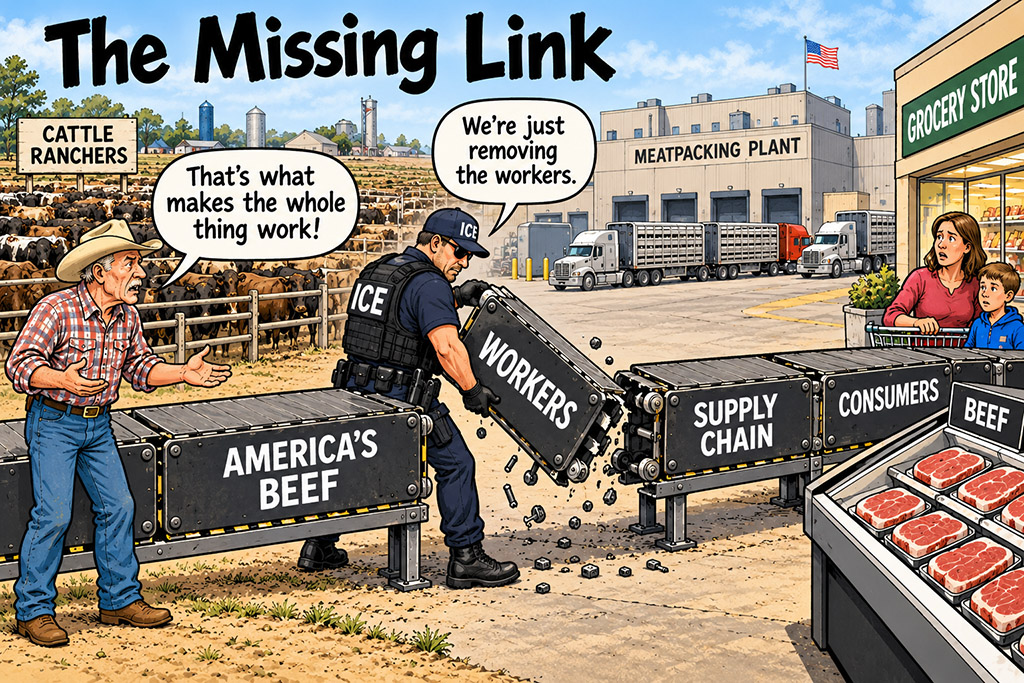
Cattle producers warn that immigration enforcement in Kansas is disrupting meat processing, delaying shipments, and increasing costs across the beef industry.
Immigration enforcement operations in southwest Kansas have disrupted one of the nation’s most important beef-processing regions, prompting cattle producers and agricultural organizations to warn about economic consequences extending well beyond the workers targeted by federal authorities.
The enforcement activity began September 22 in communities surrounding major meatpacking operations in Kansas, Oklahoma, and Texas. According to federal officials, Immigration and Customs Enforcement (ICE) arrested 104 people during the September 22–24 operation.
But the economic effects reached beyond those arrested.
Agricultural organizations reported that workers, including some legally authorized to work in the United States, stayed home out of concern about immigration enforcement. The resulting labor shortages disrupted processing schedules and delayed cattle shipments.
A Disruption to the Beef Supply Chain
Southwest Kansas is a major center of American beef production. Four large packing plants in the region have the capacity to process approximately 24,000 cattle daily, accounting for more than one-fifth of the nation’s fed-cattle slaughter capacity.
According to agricultural publication DTN/Progressive Farmer, federal slaughter data showed approximately 8,000 fewer cattle processed on September 23 and 17,000 fewer on September 24 compared with the corresponding days of the previous week.
The Kansas Livestock Association, Oklahoma Cattlemen’s Association, and Texas Cattle Feeders Association warned that the disruptions were delaying shipments, increasing costs, and causing substantial financial losses.
The organizations acknowledged the federal government’s authority to enforce immigration laws but urged officials to coordinate enforcement activities more effectively to avoid disrupting agricultural operations.
Concerns Extend Beyond Undocumented Workers
The United Food and Commercial Workers union reported that concerns about immigration enforcement affected workers with legal authorization and U.S. citizens, not just undocumented immigrants.
That distinction is significant for an industry dependent on a reliable workforce to operate processing plants, feedyards, transportation networks, and related agricultural businesses.
The Department of Homeland Security disputed descriptions of the operations as workplace raids, characterizing its activities as targeted immigration enforcement.
Nevertheless, agricultural organizations reported substantial workforce disruptions, regardless of how the federal operations were characterized.
Could Beef Prices Rise Further?
The disruptions come at a difficult time for American consumers.
Beef prices were already elevated because of tight cattle supplies, including a U.S. cattle herd near its lowest level in decades.
Interruptions in processing can create additional costs for producers and potentially constrain the supply of beef reaching consumers.
However, the extent to which the Kansas enforcement operations have affected retail beef prices has not been established.
Why It Matters to Iowa
Although the reported enforcement operations occurred primarily in southwest Kansas, the underlying economic concerns extend to agricultural states such as Iowa.
Iowa’s livestock producers and meat-processing businesses also depend on reliable labor, transportation, and processing capacity.
The Kansas experience illustrates how immigration enforcement can have economic consequences beyond the individuals directly targeted, potentially affecting producers, businesses, and consumers.
For cattle producers, the immediate concern is straightforward: animals still need to be fed, transported, and processed, regardless of whether enough workers report to the packing plants.
The broader question is how federal immigration enforcement can proceed without unnecessarily disrupting industries that depend on those workers.
Sources and verification
This story is supported by the following reporting and primary sources.
- Kansas Livestock Association joint statement — reported shipment delays, workforce disruptions, and financial losses.
- DTN/Progressive Farmer — USDA processing figures and regional packing capacity.
- U.S. Department of Justice — federal account of the operation and 104 arrests.
- Kansas News Service/KCUR — continuing effects on workers and agricultural communities.
After the Elections: Planning Another Attack on Iran
What Americans Are Learning About Plans for a Post-Election Attack on IranU.S. and Israeli military preparations for possible renewed strikes against Iran raise questions about election timing, foreign policy, and the economic consequences of another escalation.The...
Miller-Meeks Claims Credit for Unfinanced Iowa Steel Mill
Campaign follows the withdrawal of advertising support from a major Republican super PACDays after a major Republican super PAC withdrew advertising support, the Iowa congresswoman launched a campaign ad celebrating 1,700 jobs from a steel project that has yet to...
Iowa’s Fiscal Picture Improves?
The $1.1 Billion Budget Gap Tells Another StoryA modest increase in projected revenue does little to change Iowa's underlying budget problem, or the economic growth Republicans are counting on to solve it.Iowa's fiscal outlook is improving. At least, that's how Gov....
Energy Prices Push Inflation to 3.7% in September
Gasoline prices surge 34% over the past year as higher living costs continue to squeeze American householdsThe Federal Reserve is considering additional interest rate increases as American households face growing affordability challenges ahead of the midterm...
Lahn’s Running Mate Receives $540,000 Mystery Loan
The money is from an undisclosed LLC that had formed a week earlierA mysterious lender, a newly formed Illinois company, and a substantial private loan raise questions about the finances of Zach Lahn's running mate.Three weeks after Republican gubernatorial candidate...
Elon Musk’s Millions Are Helping Finance Iowa’s U.S. Senate Race
$31 million in Musk's super-PAC contributions have been spent to support the Ashley Hinton campaignTwo political organizations receiving $234 million from the billionaire since July have spent nearly $31 million supporting Ashley Hinson or opposing Josh Turek in...
Glyphosates Not Mentioned at Hinson Water Quality Event
Hinson Promises to Stand Up to Trump, but What About His Support for Monsanto's Roundup?After pledging to challenge Trump on policies harmful to Iowa, Hinson hosts a water-quality and cancer roundtable without addressing his administration's support for glyphosate.On...