Following the Data Center Money – Who Is Influencing Iowa’s Technology Growth?
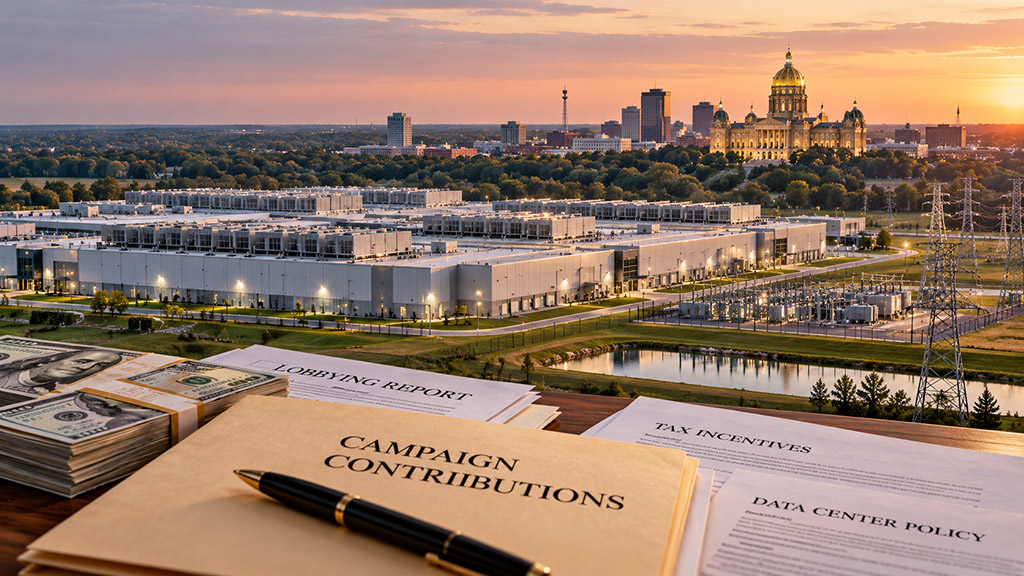
Industry lobbyists, political contributions, and a multimillion-dollar advocacy campaign reveal how data center companies are working to shape public policy.
As Iowa communities debate massive new data centers, attention has focused on electricity consumption, water use, tax incentives, and promises of economic development.
But another question deserves attention: Who is spending money to influence the policies governing these projects?
Behind the companies building data centers is a network of industry associations, lobbyists, political donors, and advocacy organizations working to influence decisions in Washington and Des Moines. Their activities are generally legal and publicly disclosed. Those records offer a revealing look at how the industry is making its case to elected officials.
Millions spent on lobbying
The Data Center Coalition represents companies operating in the rapidly expanding data-center industry. Its priorities include favorable tax policies, reliable electricity supplies, workforce development, and regulatory requirements affecting new facilities.
Federal lobbying records show approximately $3.44 million in reported expenditures and fees during 2025 and the first three quarters of 2026. The coalition maintains its own lobbying operation and has retained prominent Washington firms, including Akin Gump Strauss Hauer & Feld and Crossroads Strategies.
Its lobbying covers energy policy, taxation, tariffs, environmental issues, and technology-related legislation. The coalition also registered lobbyists with the Iowa Legislature for the 2026 session, extending its advocacy efforts to a state experiencing substantial data-center development.
Campaign contributions and congressional votes
Campaign finance records provide another window into the industry’s political relationships.
According to the Iowa Independent, Representative Mariannette Miller-Meeks received a $1,000 campaign contribution from Chris Miller, a registered Data Center Coalition lobbyist with Crossroads Strategies, one day after the House passed President Trump’s major tax and spending legislation in May 2025.
That House legislation included a proposed ten-year restriction on certain state regulation of artificial intelligence. The Senate subsequently removed the provision before the bill became law.
Miller-Meeks also received contributions from political action committees associated with major technology companies, including Google and Amazon.
Representative Ashley Hinson has received contributions from Google’s corporate PAC, including $10,000 for earlier House campaigns, $5,000 for her leadership PAC in December 2025, and $2,000 for her Senate campaign in April 2026, according to the Iowa Independent.
Hinson supported the same 2025 House legislation and has advocated streamlining federal infrastructure permitting. She also praised Google’s announced $7 billion Iowa investment, while more recently emphasizing local decision-making and residents’ concerns about electricity costs and water consumption.
These contributions do not establish that either lawmaker exchanged a vote or political favor for financial support. They do, however, illustrate how industry financial interests intersect with decisions affecting the industry’s future.
A new campaign targets Iowa
The American Infrastructure Alliance, launched in September 2026, brings together technology companies, data-center developers, investment firms, and construction labor unions. Its founding membership includes Blackstone, SoftBank, OpenAI, CoreWeave, Digital Realty, QTS, and major labor organizations. Iowa is among seven states targeted by the alliance’s advocacy efforts. According to the Des Moines Register, the organization is preparing a seven-figure Iowa advertising campaign promoting what it calls responsible data-center development.
The alliance supports standards addressing water protection, electricity infrastructure costs, job creation, and community benefits. Those objectives address legitimate concerns. But there is an important distinction between promoting enforceable protections and persuading communities to accept development proposals.
Whether the campaign produces meaningful safeguards will depend on the specific policies the alliance supports, and whether those protections become binding requirements.
Iowa’s substantial tax incentives
Iowa offers significant tax benefits to qualifying data centers. Projects meeting a $200 million investment threshold and other requirements can receive sales- and use-tax exemptions covering computers, cooling equipment, electrical infrastructure, electricity, and backup-generation fuel. Equipment exemptions are permanent. Energy-related exemptions may also be permanent for older facilities, while newer facilities generally receive exemptions lasting 10 or 15 years.
The incentives are intended to attract investment and economic development. But they also raise questions about the public costs of supporting facilities with substantial electricity and infrastructure demands.
Transparency presents another challenge.
Iowa requires certain qualifying data centers to report on their electricity and backup-fuel purchases annually. However, company-specific reports are confidential tax information.
Although aggregate data may be released, residents cannot readily examine individual facilities’ reports to assess resource consumption alongside public incentives and promised economic benefits.
Following the money, and the decisions
The available evidence does not establish that Iowa lawmakers exchanged votes for contributions or that industry organizations improperly influenced government decisions. It does establish that data center companies and their representatives are investing substantial resources in Iowa for lobbying, campaign financing, and public advocacy. Those efforts intersect with decisions about tax incentives, electricity costs, environmental safeguards, and local authority.
The industry has every right to advocate for its interests. Iowa residents have an equally legitimate interest in knowing who is financing that advocacy, which policies lawmakers support, and whether promised community protections become enforceable obligations.
The question is not simply who is building Iowa’s data centers. It is who is helping write the rules, and whether Iowans can see the full cost of the decisions being made.
Chuck Grassley’s Partisan Rhetoric Does Not Withstand Scrutiny
A Critical Thinking Exercise: Chuck Grassley's Recent Des Moines Register EditorialSelective facts, loaded language, unsupported predictions, and a billion-dollar omission reveal how political arguments can persuade without proving their conclusions.In his October 22...
Oil Hits Five-Month High of $115 a Barrel
Oil Prices Surge as Reports of New Iran Strikes Rattle Global MarketsCrude oil reaches $115 a barrel as reports of potential U.S.-Israeli strikes after the midterm elections add to concerns about energy prices, inflation, and the global economy.Global oil prices...
After the Elections: Planning Another Attack on Iran
What Americans Are Learning About Plans for a Post-Election Attack on IranU.S. and Israeli military preparations for possible renewed strikes against Iran raise questions about election timing, foreign policy, and the economic consequences of another escalation.The...
Miller-Meeks Claims Credit for Unfinanced Iowa Steel Mill
Campaign follows the withdrawal of advertising support from a major Republican super PACDays after a major Republican super PAC withdrew advertising support, the Iowa congresswoman launched a campaign ad celebrating 1,700 jobs from a steel project that has yet to...
Iowa’s Fiscal Picture Improves?
The $1.1 Billion Budget Gap Tells Another StoryA modest increase in projected revenue does little to change Iowa's underlying budget problem, or the economic growth Republicans are counting on to solve it.Iowa's fiscal outlook is improving. At least, that's how Gov....
Energy Prices Push Inflation to 3.7% in September
Gasoline prices surge 34% over the past year as higher living costs continue to squeeze American householdsThe Federal Reserve is considering additional interest rate increases as American households face growing affordability challenges ahead of the midterm...
Lahn’s Running Mate Receives $540,000 Mystery Loan
The money is from an undisclosed LLC that had formed a week earlierA mysterious lender, a newly formed Illinois company, and a substantial private loan raise questions about the finances of Zach Lahn's running mate.Three weeks after Republican gubernatorial candidate...