
A Critical Thinking Exercise: Chuck Grassley’s Recent Des Moines Register Editorial
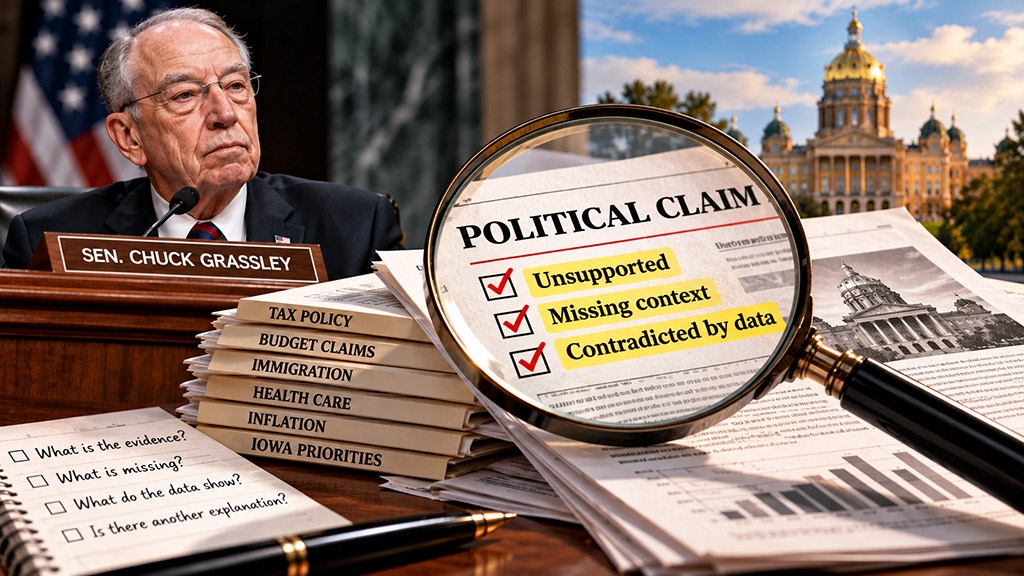
Selective facts, loaded language, unsupported predictions, and a billion-dollar omission reveal how political arguments can persuade without proving their conclusions.
In his October 22 guest editorial, “Rob Sand is a déjà vu Democrat who’d spend Iowa into ruin,” U.S. Sen. Chuck Grassley offers Iowans a warning. Elect Democrat Rob Sand as governor, and Iowa will return to the fiscal problems of the past.
Grassley presents historical budget figures, praises Republican tax policies, and predicts financial disaster under Democratic leadership. But how much of his argument is supported by evidence, and how much depends on the manipulative way that evidence is presented?
This is an opportunity to practice the important skills of critical thinking. Not by deciding whether Grassley is right or wrong because of his political affiliation, but by examining how he constructs his argument.
Selective evidence – what is missing?
Grassley reminds readers that Iowa faced a projected billion-dollar budget shortfall during Democratic Gov. Chet Culver’s administration. What he doesn’t mention is that Iowa currently faces an approximately $1.1 billion gap between projected general fund revenue and approved spending under Republican leadership.
The circumstances are different. Iowa has substantial reserves available to finance its current budget, and the state is not facing an immediate inability to pay its obligations. But that distinction does not eliminate the need for comparison.
Grassley uses a billion-dollar budget problem as evidence of Democratic fiscal irresponsibility while omitting a comparable-sized gap under Republicans.
Critical thinking question: Would readers reach the same conclusion if both sets of figures appeared in the editorial?
Missing context: what was happening in 2010?
Grassley describes Iowa’s financial difficulties under Culver without meaningfully addressing the Great Recession. At the time, the national economy had experienced its worst downturn in decades. Unemployment rose, tax revenues declined, and state governments across the country struggled to balance their budgets.
Culver’s decisions can be evaluated and criticized. But evaluating those decisions without acknowledging the economic crisis risks giving readers a misleading impression of what caused Iowa’s budget problems.
Critical thinking question: Does the argument distinguish between financial problems caused by government decisions and those caused by economic conditions beyond the government’s control?
Guilt by association: Is Rob Sand Chet Culver?
Grassley writes “Sand wants to budget like Culver.” But he provides no detailed comparison of their fiscal proposals. The argument depends on a political association. Culver was a Democrat, Sand is a Democrat, and therefore Sand would govern like Culver. That is not evidence of what Sand would actually do.
A stronger argument would identify Sand’s proposed expenditures, tax policies, and financing plans, then evaluate their likely budget consequences.
Critical thinking question: What specific evidence connects Sand’s proposals to the fiscal outcomes Grassley predicts?
Loaded language: persuasion through emotion
Grassley describes Sand as someone who would “spend like a socialist” and return Iowa to a “doomsday of deficits and debt.” He also characterizes Sand’s campaign as a “make-believe fairy tale” built on “hocus pocus.” These expressions communicate disapproval, but they provide no additional evidence.
Words such as socialist, doomsday, and hocus pocus are designed to influence how readers feel about a candidate. They do not explain what the candidate proposes or whether those proposals are financially sustainable.
Critical thinking question: If the emotional language were removed, how much evidence would remain to support the accusation?
Unsupported predictions – how does Grassley know?
Grassley confidently predicts that Sand will produce excessive spending, deficits, and debt.
Predictions are legitimate parts of political debate. But they require a defensible connection between present evidence and future outcomes. The editorial does not present a costed Sand budget, demonstrate that his proposed revenues would be insufficient, or explain how his policies would produce the predicted financial crisis.
Instead, it asks readers to accept the forecast largely on the strength of Grassley’s warning.
Critical thinking question: Is this a conclusion supported by evidence, or a possibility presented as a certainty?
Confusing policy with results
Grassley credits Republican income-tax reductions with attracting jobs, investment, and economic growth. Iowa’s tax rates have indeed fallen substantially. But reducing tax rates and demonstrating economic success are not the same thing.
Iowa’s economic performance has been uneven. The state experienced a slight contraction in the first quarter of 2026, followed by second-quarter growth below the national rate. That does not establish that tax cuts caused weak performance. It also does not establish that tax cuts caused the growth Grassley celebrates.
To demonstrate that relationship, readers would need evidence connecting the tax changes to measurable economic outcomes.
Critical thinking question: Is Grassley demonstrating that the policy worked, or simply asserting that it worked because the policy was enacted?
The false choice: Republicans or financial ruin
Grassley’s editorial presents a remarkably simple choice. Continue Republican leadership and preserve fiscal responsibility or elect Sand and return to financial disaster. But fiscal policy involves more than choosing between two political parties.
Republican administrations can make sound or unsound budget decisions. Democratic administrations can do the same. The relevant questions concern projected revenues, spending commitments, economic performance, reserves, and the sustainability of proposed policies.
Reducing those questions to party identity discourages readers from evaluating the actual choices.
Critical thinking question: Are voters being asked to compare policies, or simply to fear one political party?
The double standard: who gets credit, and who gets blame?
Perhaps the most revealing feature of Grassley’s editorial is the difference in how he assigns responsibility. The financial problems of 2010 are attributed to Democratic leadership, with little discussion of the national recession.
The current Republican administration receives credit for tax reductions, reserves, and economic performance, without discussion of the substantial gap between recurring revenues and spending.
This is not necessarily evidence that every one of Grassley’s claims is false. It is evidence that he applies different levels of scrutiny depending on which party is being evaluated.
Critical thinking question: Would the same standard of fiscal responsibility produce the same judgment if the political parties were reversed?
The larger lesson – facts can be accurate and arguments still misleading
One of the most important lessons in critical thinking is that misinformation does not always require false statements. An argument can use accurate numbers, genuine historical events, and legitimate policy accomplishments while still leading readers toward a conclusion that the evidence does not establish.
It can do so by omitting relevant facts, removing historical context, using emotionally charged language, confusing correlation with causation, or presenting speculation as certainty.
That is what makes Grassley’s editorial worth examining. His concerns about fiscal responsibility are legitimate. His account includes historical events that deserve consideration. Republican tax reductions and accumulated state reserves are real policy developments.
But those facts do not establish that Rob Sand would govern like Chet Culver, that Iowa’s present fiscal strategy is sustainable, or that Republican leadership necessarily produces better economic results.
Those conclusions require additional evidence.
The goal of critical thinking
The goal of critical thinking is not to reject an argument because we disagree with its author. It is to ask whether the evidence actually supports the conclusion. And that standard should apply to Chuck Grassley, Rob Sand, Zach Lahn, and everyone else seeking to influence Iowa voters.
Before accepting a political argument, ask three simple questions. What evidence is being presented? What relevant information might be missing? And, does the evidence actually support the conclusion?
Those questions won’t tell you which candidate to support. They will help you recognize when someone is trying to make that decision for you.
Following the Data Center Money in Iowa
Following the Data Center Money - Who Is Influencing Iowa's Technology Growth?Industry lobbyists, political contributions, and a multimillion-dollar advocacy campaign reveal how data center companies are working to shape public policy.As Iowa communities debate...
Oil Hits Five-Month High of $115 a Barrel
Oil Prices Surge as Reports of New Iran Strikes Rattle Global MarketsCrude oil reaches $115 a barrel as reports of potential U.S.-Israeli strikes after the midterm elections add to concerns about energy prices, inflation, and the global economy.Global oil prices...
After the Elections: Planning Another Attack on Iran
What Americans Are Learning About Plans for a Post-Election Attack on IranU.S. and Israeli military preparations for possible renewed strikes against Iran raise questions about election timing, foreign policy, and the economic consequences of another escalation.The...
Miller-Meeks Claims Credit for Unfinanced Iowa Steel Mill
Campaign follows the withdrawal of advertising support from a major Republican super PACDays after a major Republican super PAC withdrew advertising support, the Iowa congresswoman launched a campaign ad celebrating 1,700 jobs from a steel project that has yet to...
Iowa’s Fiscal Picture Improves?
The $1.1 Billion Budget Gap Tells Another StoryA modest increase in projected revenue does little to change Iowa's underlying budget problem, or the economic growth Republicans are counting on to solve it.Iowa's fiscal outlook is improving. At least, that's how Gov....
Energy Prices Push Inflation to 3.7% in September
Gasoline prices surge 34% over the past year as higher living costs continue to squeeze American householdsThe Federal Reserve is considering additional interest rate increases as American households face growing affordability challenges ahead of the midterm...
Lahn’s Running Mate Receives $540,000 Mystery Loan
The money is from an undisclosed LLC that had formed a week earlierA mysterious lender, a newly formed Illinois company, and a substantial private loan raise questions about the finances of Zach Lahn's running mate.Three weeks after Republican gubernatorial candidate...