
Austin Harris, A First-Term Lawmaker Building a Culture-War Portfolio
Legislative Profile
Iowa Rep. Austin Harris is a first-year legislator who has quickly emerged as one of the Iowa House’s most active sponsors of legislation tied to the national Republican culture-war agenda. Though he is new to elected office, Harris has already taken a central role in shaping bills that target public education, public assistance programs, and political speech, often using the language of “integrity,” “accountability,” and “public safety” to justify proposals that critics say expand government control over everyday life.
Harris’s background reflects a path that has become increasingly common in Iowa politics: a young political operative moving into office through party networks rather than through long public-service experience in fields like education, healthcare, agriculture, or local government.
His prior work for U.S. Rep. Mariannette Miller-Meeks helped place him inside the Republican political ecosystem, and his legislative output suggests he is not attempting to be a quiet freshman. He is positioning himself as an aggressive enforcer of a political worldview that prioritizes ideological conformity, punishment-based governance, and culture-war messaging over practical problem-solving.
A legislative pattern: “Government is the problem,” except when it’s enforcing ideology
Harris’s bill sponsorship shows a clear theme. He frequently frames government programs as vulnerable to “waste, fraud, and abuse,” while simultaneously supporting expanded state authority in schools, social policy, and public behavior. This contradiction, hostility to government spending paired with enthusiasm for government enforcement, is not unique to Harris, but he appears to be making it a signature.
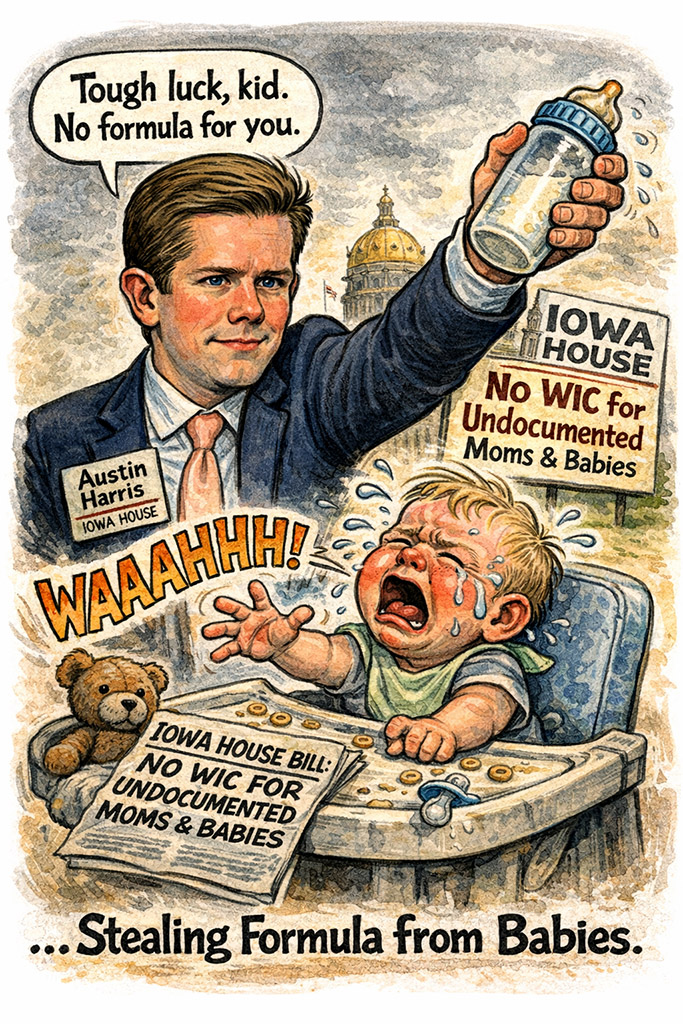
This pattern is especially visible in proposals affecting public assistance and education. Harris has supported “program integrity” measures that sound responsible in the abstract, but in practice often function as barriers that disproportionately affect low-income families, immigrants, and people in crisis. The WIC proposal debated in February is a prime example: a program designed to prevent malnutrition among pregnant women, infants, and small children was pulled into an ideological immigration fight, with the predictable result that the most vulnerable people would bear the consequences.
Education bills: more oversight, more punishment, more politics
Many of Harris’s bills align with the Iowa GOP’s multi-year campaign to weaken public schools while elevating alternatives such as private schools, charter schools, and Education Savings Accounts. His proposals include measures that increase reporting requirements, impose new restrictions on instruction, and add civil penalties.
These bills are frequently marketed as “transparency” or “parental rights,” but they also create new enforcement mechanisms that can intimidate teachers and administrators as they increase bureaucracy in a system already strained by staffing shortages and funding disputes.
Harris has also signed onto legislation that places political litmus tests into higher education policy, including bills targeting student organizations accused of supporting terrorism and restricting access to financial aid based on political speech or association. Whether one agrees or disagrees with the politics of those organizations, the trend is clear: the state is being invited into the role of deciding which viewpoints are acceptable, and which are punishable.
Law-and-order branding and symbolic politics
Harris’s legislative record also includes bills centered on law enforcement benefits, bail restrictions, and criminal penalties. These are consistent with a broader Republican identity-politics approach of emphasizing “public safety” as a cultural brand while often ignoring the deeper drivers of safety, like mental health, housing instability, poverty, addiction, and lack of access to healthcare.
In short, Harris’s legislative profile is not built around pragmatic governance. It is built around ideological signaling and enforcement. His bills rarely focus on Iowa’s most urgent challenges: rural hospital stability, OB/GYN shortages, childcare affordability, workforce retention, water quality, housing supply, or property tax fairness for working families.
Instead, his most visible work centers on policing behavior, restricting eligibility, and regulating speech, particularly in schools and public institutions.
Our Take (Iowa411)
Austin Harris represents a growing political model in Iowa: a legislator who does not enter office primarily to solve problems, but to wage an ideological campaign through legislation. His record suggests he is not trying to improve public systems. Instead, he is trying to reshape them into tools for cultural enforcement.
Iowans should pay close attention to lawmakers like Harris, not because they are flamboyant or loud, but because their proposals can quietly restructure daily life, like who gets food assistance, what teachers can safely say, what students can safely organize, and what rights are treated as “privileges” subject to political approval.
This is not small government. It is government power redirected away from public benefit, and toward political control.

Breaking With Trump, or Just His Poll Numbers?
Candidates show some dissent over the Iran war, as Grassley and Ernst vote against limiting Trump’s war powersIowa Republican candidates are changing their positions on the Iran war as Election Day approaches. That is news. Calling it a “break with Trump” may be...
Has the UI Center Lost Its Academic Legitimacy?
How Much Academic Legitimacy Does Iowa's Center for Intellectual Freedom Have Left?Eleven scholars recruited to help establish the Center have resigned. Their departure raises a bigger question about what made this politically created institution academic in the first...
Trump Lost His Lawsuit. But Did the Lawsuit Fail?
An Iowa judge threw out Donald Trump’s lawsuit against Gannett and pollster J. Ann Selzer. But after nearly two years of litigation, the case raises a larger question about what it means to “win.”President Donald Trump lost his lawsuit against Gannett (owner of the...
As Iowans Suffer, Grassley Turns His Focus to Transgender Sports
Iowa already prohibits transgender girls from competing in girls' sports. With farmers struggling with diesel prices and families confronting inflation and housing costs, why is Chuck Grassley making the issue a national priority now?Should we be concerned about his...
Would a Ban of Diesel Exports Actually Lower Prices? Likely Not.
It’s More Complicated Than Grassley BelievesSen. Chuck Grassley says the U.S. should stop exporting diesel to bring down prices for farmers and truckers. The oil industry says that could backfire. Its explanation deserves a closer look.Iowa farmers are heading into...
Iowa Corn Growers Ask for Diesel Price Relief as Harvest Begins
Iowa Corn Growers Association asks for diesel relief as harvest kicks offBy Cami KoonsIowa Capital Dispatch As Iowa farmers begin harvesting their crops, corn growers in the state are asking Iowa congressional delegates to help lower the cost of diesel fuel, which has...
Mortgage Rates Hit 7% as War Increases Housing Market Pressure
Higher energy prices, persistent inflation, and rising borrowing costs are making an already difficult housing market even harder for buyers.The New York Times reports that mortgage rates have climbed above 7% for the first time since January 2025, another economic...