
Biofuels Boost or Political Optics? Farmers Still Struggling
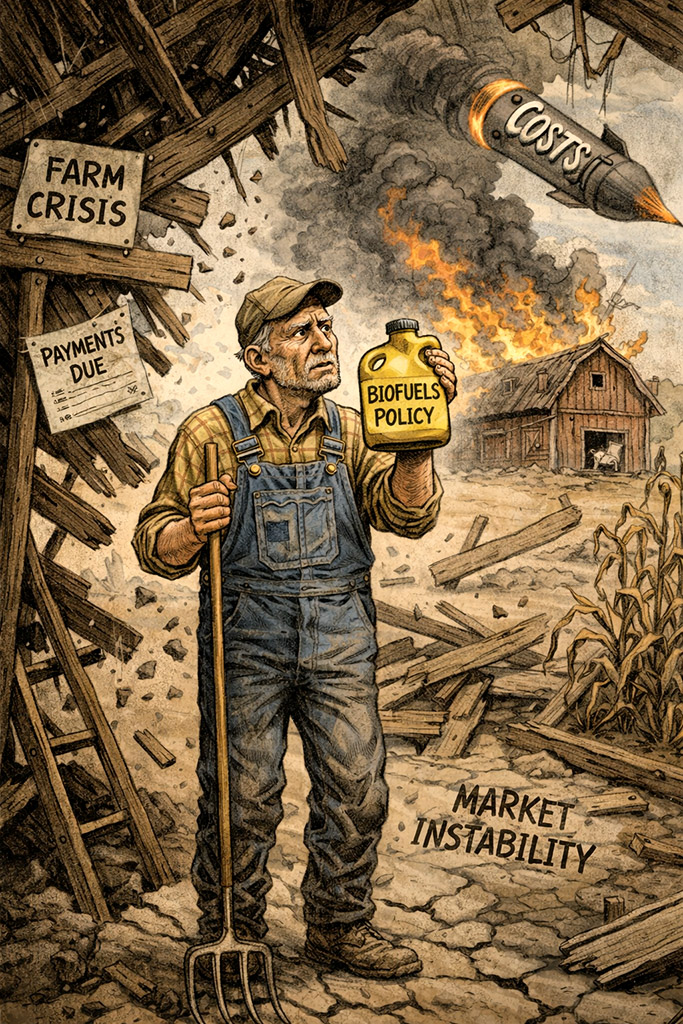
President Donald Trump announced new Renewable Fuel Standard (RFS) mandates for 2026 and 2027 at record levels, drawing praise from Iowa Republican leaders and biofuels advocates who say the move will increase demand for corn and soybeans and support rural economies.
The announcement, made during a White House agriculture event, includes expanded ethanol and biodiesel blending requirements and renewed calls for year-round E15 gasoline sales. Supporters, including Sens. Joni Ernst and Chuck Grassley and Iowa Agriculture Secretary Mike Naig, argue the policy will strengthen energy independence, stabilize biofuel markets, and provide economic benefits across farm country.
Federal officials estimate the updated standards could generate more than $10 billion in economic activity and support over 100,000 jobs. However, critics say the announcement comes at a time when the broader farm economy is under significant stress, and question whether the move meaningfully addresses those challenges.
Farm income is projected to decline, agricultural exports have fallen sharply amid trade disruptions, and farm bankruptcies rose 46% in 2025. Rising fuel and fertilizer costs, driven in part by geopolitical tensions, have further strained already thin margins.
Some farmers argue that federal payments and policy adjustments fall far short of offsetting losses tied to tariffs, market instability, and rising input costs.
Our Take
There are two narratives here, and they don’t align. On paper, increasing biofuel mandates should boost demand for corn and soybeans. That’s the theory, and politically, it’s an easy win in Iowa. But in practice, this looks less like meaningful relief and more like a narrow, supply-side adjustment being presented as a comprehensive solution.
The timing matters, as farm income is declining, bankruptcies are rising, input costs are climbing, and export markets remain unstable. Against that backdrop, increasing blending requirements may help at the margins, but it does not address the structural pressures farmers are facing.
This raises a harder question. Is this policy designed to materially improve farm economics, or to signal support? There is also a broader economic dynamic at play. Expanding biofuel supply can help moderate fuel prices, which benefits consumers. But that same pressure can limit how much farmers gain from increased demand.
In that sense, the policy may be trying to accomplish two competing goals, to lower energy costs and increase farm revenue. Those objectives don’t always move in the same direction.
The result is a policy that looks impactful politically but may deliver only incremental relief economically. At a time when farmers are facing systemic challenges, this risks being perceived not as a solution, but as a distraction or stopgap.
What the Fundraising Reports Are Beginning to Tell Us
What the Candidate Fundraising Reports Are Beginning to Tell UsBeyond the Dollars: Emerging Fundraising Trends in Iowa's 2026 Elections A Look Into Early Iowa Campaign Financing Reports Every campaign finance reporting period produces a familiar set of headlines about...
Editorial: Beyond One Candidate, Election, and Lawsuit
Iowa judge to decide if Libertarian governor ticket will be on ballotAn Iowa411 EditorialWho Should Decide Ballot Access: Courts or Voters? In the coming days, a Polk County judge will decide whether Libertarian candidates Nicholas Gluba and Jules Cutler will appear...
What Fundraising Reports Reveal About the Iowa Governor’s Race
Beyond the Dollars: What Campaign Fundraising Reports Reveal About the Iowa Governor's RaceIowa Politics Analysis Campaign finance reports often produce a single headline about who raised the most money. This reporting period certainly did. Democratic gubernatorial...
Iowa Layoffs Hit One-Year High, Most Are Manufacturing Jobs
Iowa Layoffs Reach One-Year High as Manufacturing Sector Leads June Job LossesIowa Economy Brief Iowa employers announced 656 layoffs in June, the highest monthly total in a year, with manufacturing accounting for most of the job losses, according to Iowa's Worker...
Iowa Religious Leaders Gather to Support Voting Rights
Iowa Faith Leaders Gather to Support the Moral Issue of Our Time - Voting RightsFaith Gathering to Support Voting Rights Des Moines Register writer Isabelle Foland reported that religious leaders from across Iowa gathered in downtown Des Moines earlier this month to...
Reynolds’ Medicaid Task Force to Examine a Miniscule Problem
Reynolds Creates Medicaid Fraud Task Force as Iowa Reports One of Nation's Lowest Improper Payment RatesNew panel aims to eliminate fraud, waste and abuse while state already performs well below national average Gov. Kim Reynolds has created a new task force to combat...
As Opposition Grows, Iowa Continues to Recruit Data Centers
State actively markets Iowa to technology companies as communities debate costs and benefitsState actively markets Iowa to technology companies as communities debate costs and benefits As several proposed data center projects encounter growing local opposition, Iowa...