
Iowa’s Data Center Boom: What Are the Tradeoffs?
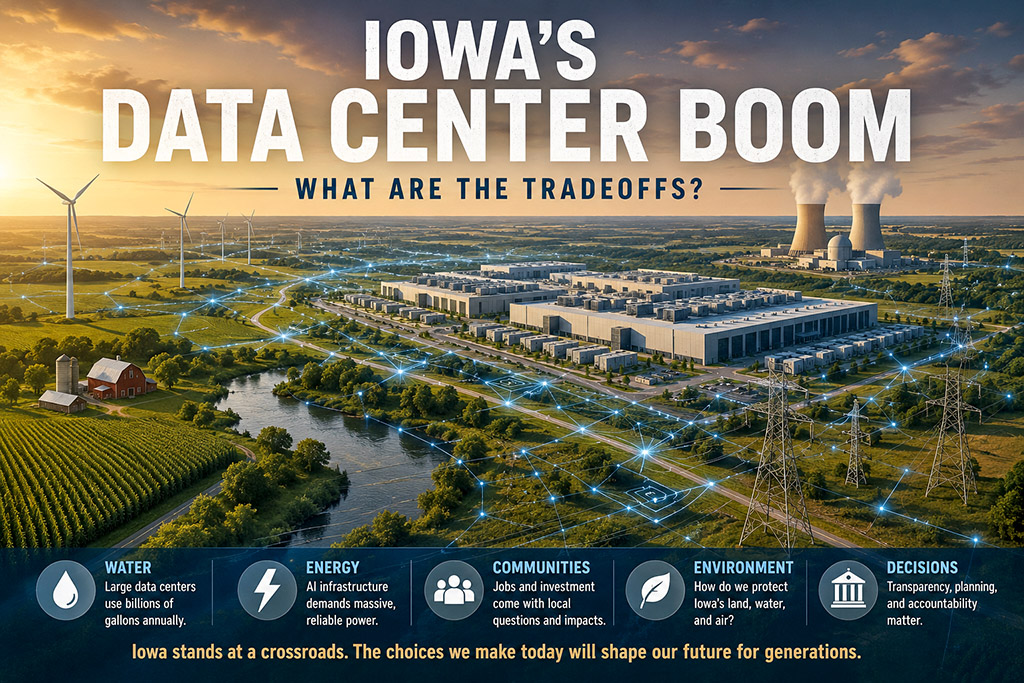
As technology companies invest billions in Iowa, communities are asking questions about water, energy, and what they receive in return
For nearly two decades, Iowa has become an increasingly attractive destination for some of the world’s largest technology companies. Google, Microsoft, Meta, and others have invested billions of dollars in data centers across the state, attracted by available land, relatively affordable electricity, favorable tax policies, and a central location within the United States.
Mixed reactions to data centers
Supporters see these investments as a sign that Iowa is participating in the future economy as critics worry Iowa may be giving away too much in return.
As new data center projects emerge and existing facilities expand, communities across Iowa are beginning to ask a simple question.
What are the tradeoffs?
The question is not whether technology is good. The question is whether Iowa has fully examined the long-term impacts of becoming a major hub for data centers and artificial intelligence infrastructure.
The benefits are real
Any honest discussion must begin there. Google says it has invested approximately $20 billion in Iowa since first breaking ground in Council Bluffs in 2007.
Data center projects generate construction jobs, local tax revenues, infrastructure improvements, economic development activity, and long-term technology investment.
Investment in conservation projects
Supporters also note that companies such as Google have invested in conservation projects, educational initiatives, and community partnerships.
Most recently, Google announced an additional $1.7 million investment in Iowa water-quality efforts, bringing its water-related conservation investments in the state to approximately $5.5 million since 2024. Those projects appear legitimate and beneficial. Improved water quality, stream restoration, wetland preservation, and reduced nutrient runoff help communities regardless of one’s views about data centers.
The conservation work should be recognized. But that is only part of the conversation.
Water: The question everyone understands
Water has emerged as the most visible concern. Google’s most recent sustainability report shows that its Council Bluffs facilities consumed approximately one billion gallons of water last year.
At first glance, the amount is staggering. The challenge is that most people have no context for what a billion gallons represents. How does that compare to municipal water use? Agricultural use? Industrial use? And what are the future growth projections?
Most importantly, how much water can Iowa communities sustainably provide during periods of drought?
These are the questions residents raised recently during discussions surrounding Google’s proposed data center development near Palo in Linn County. Some residents expressed concern about impacts on local water supplies, community wells, and future drought conditions. Others questioned whether state permitting processes alone are sufficient to evaluate long-term sustainability.
Those concerns are neither anti-technology nor unreasonable. Water is a finite resource. And the larger the project, the more important the questions become.
Energy: The other resource debate
Water may be receiving most of the attention today. Energy could become the larger issue tomorrow.
Modern data centers consume enormous amounts of electricity. Artificial intelligence systems require even greater computing power, and energy demands than traditional data storage facilities.
The proposed restart of Iowa’s Duane Arnold nuclear plant illustrates the scale of that demand. The facility’s reopening is tied directly to long-term agreements supplying electricity to large-scale data center operations.
For some, this represents a promising example of clean-energy infrastructure supporting economic growth. For others, it raises new questions. Who pays for the infrastructure needed to support future growth? Will local ratepayers bear any of the costs? And how should Iowa balance residential, agricultural, industrial, and technology-sector energy demands?
Again, these are not arguments against development. They are questions about planning.
Impacts on neighbors
Water and energy are not the only concerns. Across the country, residents living near large data centers have complained about continuous noise from cooling systems, backup generators, light pollution, increased local traffic, land-use changes, and property impacts.
These concerns have received increasing national attention. Consumer advocate Erin Brockovich recently launched an initiative focused specifically on data center transparency and community impacts, citing growing concerns from residents across multiple states.
Supporters of data centers often describe them as clean and unobtrusive, but many neighbors describe a more complicated reality. As Iowa communities evaluate future projects, local quality-of-life impacts will likely become a larger part of the discussion.
Jobs versus resource use
Perhaps the most politically sensitive question is also the most straightforward. What does Iowa receive in return for the consumption of its resources? Data centers require billions of dollars in investment and consume significant resources. Unlike manufacturing facilities, however, they often employ relatively small permanent workforces once construction is complete.
That does not mean they lack economic value. It does mean communities have a legitimate interest in understanding how the benefits compare to the demands being placed on local resources and infrastructure.
Economic development in this case is not simply about attracting investment, it also concerns a determination of whether the benefits justify the costs.
A familiar Iowa debate
In many ways, this conversation is not new. Iowa has wrestled with similar questions involving ethanol plants, wind farms, solar projects, carbon pipelines, livestock operations, and other major developments.
The details may change, but the underlying questions remain remarkably similar. Who benefits? Who bears the costs? How are risks managed? What protections exist for local communities? And how much public support is appropriate?
Data centers are simply the latest chapter in a broader discussion about how Iowa uses its land, water, energy, and natural resources.
The Bottom Line
The debate over data centers is often presented as a choice between economic development and environmental concerns.
That is a false choice. Iowa can support technological growth while also demanding transparency, accountability, and responsible resource management.
The real question is not whether data centers should exist in Iowa. They already do.
The real question is whether Iowans have enough information to evaluate the long-term impacts of the state’s rapidly growing data center economy. Before Iowa commits additional water, energy, land, and public resources to future projects, citizens deserve clear answers about costs, benefits, risks, and tradeoffs.
That is not opposition to progress. It is how responsible planning looks.
Breaking With Trump, or Just His Poll Numbers?
Candidates show some dissent over the Iran war, as Grassley and Ernst vote against limiting Trump’s war powersIowa Republican candidates are changing their positions on the Iran war as Election Day approaches. That is news. Calling it a “break with Trump” may be...
Has the UI Center Lost Its Academic Legitimacy?
How Much Academic Legitimacy Does Iowa's Center for Intellectual Freedom Have Left?Eleven scholars recruited to help establish the Center have resigned. Their departure raises a bigger question about what made this politically created institution academic in the first...
Trump Lost His Lawsuit. But Did the Lawsuit Fail?
An Iowa judge threw out Donald Trump’s lawsuit against Gannett and pollster J. Ann Selzer. But after nearly two years of litigation, the case raises a larger question about what it means to “win.”President Donald Trump lost his lawsuit against Gannett (owner of the...
As Iowans Suffer, Grassley Turns His Focus to Transgender Sports
Iowa already prohibits transgender girls from competing in girls' sports. With farmers struggling with diesel prices and families confronting inflation and housing costs, why is Chuck Grassley making the issue a national priority now?Should we be concerned about his...
Would a Ban of Diesel Exports Actually Lower Prices? Likely Not.
It’s More Complicated Than Grassley BelievesSen. Chuck Grassley says the U.S. should stop exporting diesel to bring down prices for farmers and truckers. The oil industry says that could backfire. Its explanation deserves a closer look.Iowa farmers are heading into...
Iowa Corn Growers Ask for Diesel Price Relief as Harvest Begins
Iowa Corn Growers Association asks for diesel relief as harvest kicks offBy Cami KoonsIowa Capital Dispatch As Iowa farmers begin harvesting their crops, corn growers in the state are asking Iowa congressional delegates to help lower the cost of diesel fuel, which has...
Mortgage Rates Hit 7% as War Increases Housing Market Pressure
Higher energy prices, persistent inflation, and rising borrowing costs are making an already difficult housing market even harder for buyers.The New York Times reports that mortgage rates have climbed above 7% for the first time since January 2025, another economic...