Iowa’s Voter Data Sharing Raises Questions About Privacy and Transparency
An Iowa411 Editorial
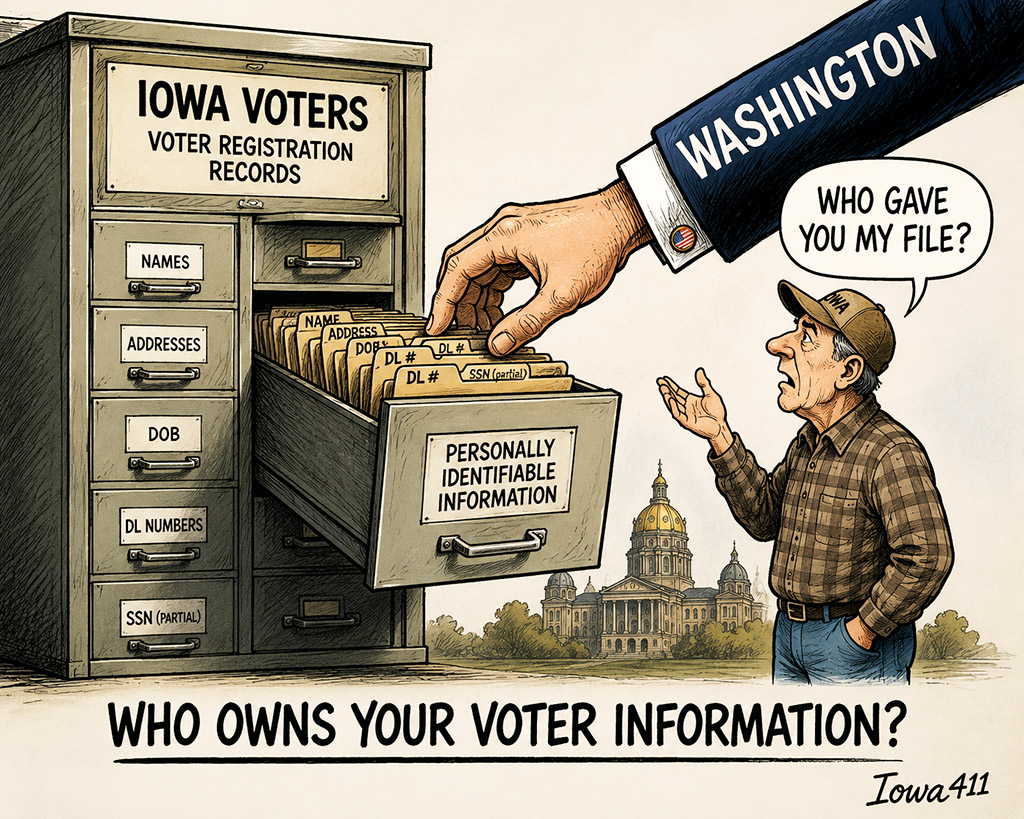
Who Owns Your Voter Information?
When Iowa Secretary of State Paul Pate announced that his office had provided voter registration data, including driver’s license numbers and partial Social Security numbers, to the U.S. Department of Justice, many Iowans probably never heard about it. They should have.
Not because there is evidence that their personal information has been misused. And not because maintaining accurate voter rolls isn’t an important responsibility.
Rather, because the episode raises fundamental questions about privacy, state authority, federal power, and public trust. Those questions deserve public discussion.
A National Campaign
Iowa did not receive the request in isolation. The Department of Justice has sought detailed voter registration information from dozens of states as part of a broader effort to identify ineligible registrations and strengthen election integrity. The administration has argued that federal law authorizes these requests and that maintaining accurate voter rolls is essential to protecting elections.
Many states have disagreed. Some provided public versions of voter registration records, and others refused to release sensitive personal information. Several states challenged the requests in federal court.
So far, judges in multiple states including Connecticut, Maine, Wisconsin, California, Michigan, Arizona, and others have rejected or dismissed DOJ efforts to compel production of detailed voter information, finding that the federal government had not demonstrated the legal authority it claimed under the Civil Rights Act.
Iowa took a different path. Secretary Pate chose to comply after consulting with his legal staff and the Iowa Attorney General’s Office.
What Information Was Shared?
According to Iowa officials, the records provided included personally identifying information such as driver’s license numbers and partial Social Security numbers as part of the state’s voter registration database.
That understandably raises questions for many voters. Who now possesses that information? How is it being stored? Who has access to it? How long will it be retained? Will it be used only for verifying voter eligibility? Could it eventually become part of a broader federal voter database?
Those questions deserve clear public answers regardless of political affiliation.
Why This Matters
Election administration has traditionally been one of the clearest examples of American federalism. The U.S. Constitution gives states primary responsibility for conducting elections, while Congress establishes certain national standards.
That balance has existed for generations. The recent disputes are not simply about voter lists; they are also about where the line should be drawn between state authority and federal oversight. Federal courts have repeatedly reminded both sides that legal authority, not political preference, must determine that boundary.
Public Confidence Depends on Transparency
Reasonable people can disagree about how aggressively governments should verify voter eligibility, but transparency should not be controversial.
If voter information is shared with another level of government, citizens deserve to know what information was provided, why it was requested, what legal authority supported the request, how the information will be protected, and how it will ultimately be used.
Those are not partisan questions. They are questions of public accountability.
Ryan Peterman’s Request
Democratic Secretary of State candidate Ryan Peterman’s public records requests should be viewed through that broader lens. Regardless of the political outcome, obtaining documentation showing what information was shared, what legal analysis supported the decision, and how the state evaluated voter privacy serves an important public purpose. Because government transparency benefits everyone.
Whether one agrees or disagrees with Iowa’s decision, understanding how that decision was made strengthens public confidence far more than speculation ever could.
Our Take
Election integrity and voter privacy should never be treated as competing values, because both matter. States have a legitimate responsibility to maintain accurate voter rolls and citizens have a legitimate expectation that their personal information will be handled carefully, lawfully, and transparently.
Federal courts continue to define the limits of the Justice Department’s authority in this area, and those legal questions remain active. Meanwhile, Iowa voters deserve a clear accounting of what information was shared, why it was shared, and what safeguards exist to protect it.
Public trust depends not only on secure elections, it also depends on open government.
At a Glance
What happened? Iowa shared voter registration data with the U.S. Department of Justice.
Why? Iowa officials concluded federal law authorized the request.
Why is it controversial? Many states refused similar requests, and several federal courts have rejected DOJ’s legal arguments.
Why should I care? The issue raises questions about voter privacy, election administration, state authority, and government transparency.
Breaking With Trump, or Just His Poll Numbers?
Candidates show some dissent over the Iran war, as Grassley and Ernst vote against limiting Trump’s war powersIowa Republican candidates are changing their positions on the Iran war as Election Day approaches. That is news. Calling it a “break with Trump” may be...
Has the UI Center Lost Its Academic Legitimacy?
How Much Academic Legitimacy Does Iowa's Center for Intellectual Freedom Have Left?Eleven scholars recruited to help establish the Center have resigned. Their departure raises a bigger question about what made this politically created institution academic in the first...
Trump Lost His Lawsuit. But Did the Lawsuit Fail?
An Iowa judge threw out Donald Trump’s lawsuit against Gannett and pollster J. Ann Selzer. But after nearly two years of litigation, the case raises a larger question about what it means to “win.”President Donald Trump lost his lawsuit against Gannett (owner of the...
As Iowans Suffer, Grassley Turns His Focus to Transgender Sports
Iowa already prohibits transgender girls from competing in girls' sports. With farmers struggling with diesel prices and families confronting inflation and housing costs, why is Chuck Grassley making the issue a national priority now?Should we be concerned about his...
Would a Ban of Diesel Exports Actually Lower Prices? Likely Not.
It’s More Complicated Than Grassley BelievesSen. Chuck Grassley says the U.S. should stop exporting diesel to bring down prices for farmers and truckers. The oil industry says that could backfire. Its explanation deserves a closer look.Iowa farmers are heading into...