
How Iowa Lawmakers Are Spending the Final Days of the 2026 Session, and Why It Matters
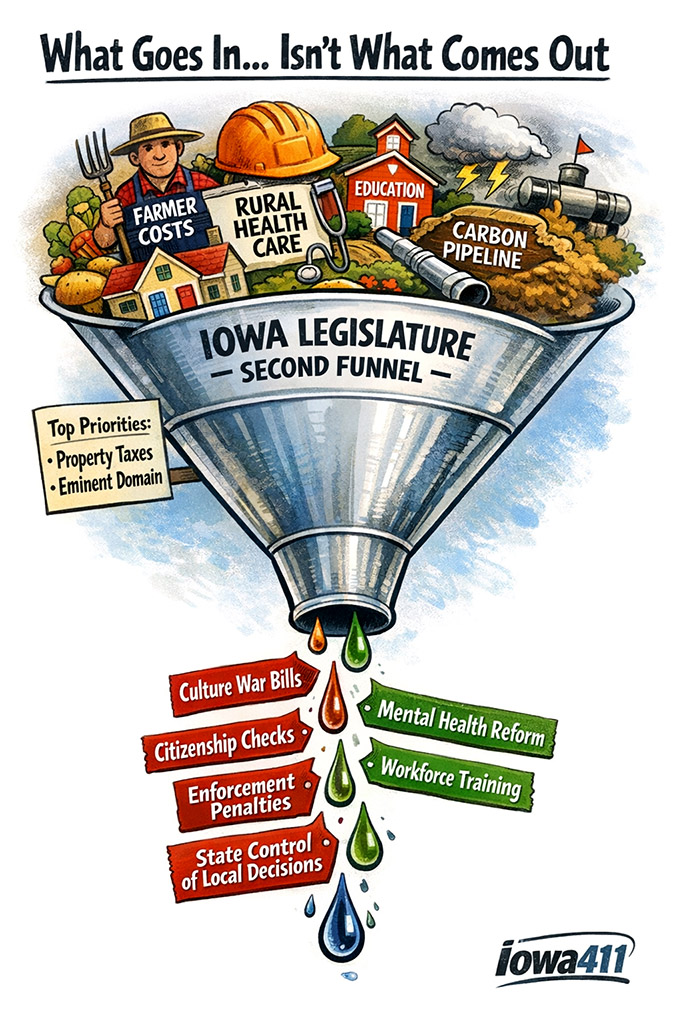
As the 2026 Iowa legislative session winds down, a clear pattern has emerged. Instead of focusing on core challenges facing Iowans like rural healthcare access, workforce shortages, farm profitability, and economic development, lawmakers have advanced a series of bills aligned more closely with national political priorities than state-specific needs.
Moving Through the Iowa Legislature
In the final stretch of the session, lawmakers have moved a wide range of legislation touching agriculture, healthcare, education, and civil governance. These include measures to limit lawsuits against agricultural producers for greenhouse gas emissions, expand access to ivermectin while altering public health and nutrition policies, and restrict foreign involvement in healthcare systems and ballot initiatives. Current Iowa legislative agenda.
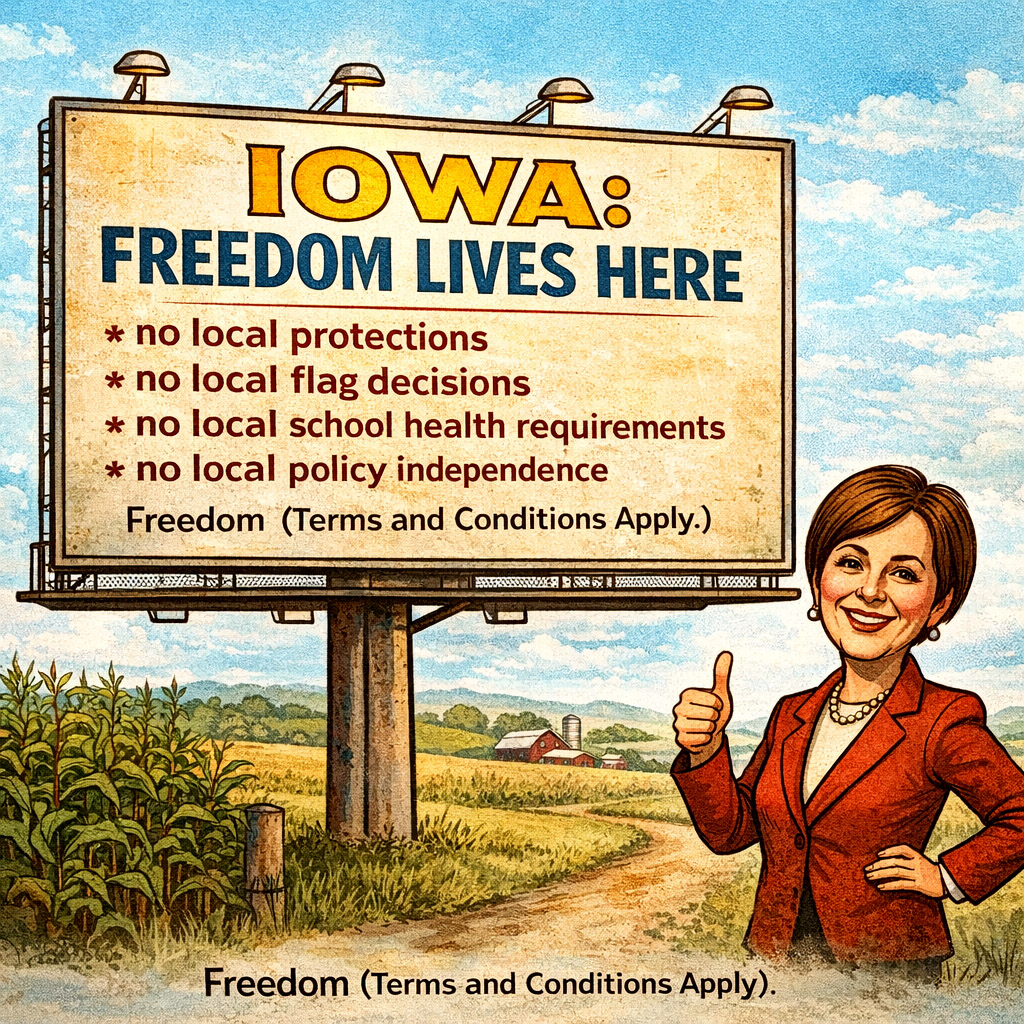
Additional proposals impose new requirements on schools and libraries, roll back diversity, equity, and inclusion initiatives in higher education, and limit the ability of local governments to enact civil rights protections or issue community identification programs. While a small number of these efforts, particularly those addressing foreign influence, have received bipartisan support, many others have raised concerns about their underlying intent and practical impact.
A Clear Pattern: National Politics Driving State Policy
Taken together, these actions point to a broader shift in how policy is being shaped in Iowa. Rather than centering on locally driven problem-solving, much of the legislation reflects alignment with national political narratives. At the same time, there is a noticeable movement toward consolidating authority at the state level, often at the expense of local control and institutional independence.
This trend is accompanied by a weakening of traditional accountability mechanisms, including limits on legal challenges and oversight, as well as a growing tendency to frame policy, particularly in healthcare, through political lenses rather than established scientific consensus. The result is a legislative environment that increasingly mirrors national ideological priorities rather than Iowa-specific needs.
Potential Impacts on Iowans
Some elements of the legislation may offer targeted benefits, such as providing legal clarity and protection for agricultural producers or addressing concerns about foreign influence in critical sectors. There are also efforts, at least in principle, to promote healthier lifestyles through nutrition and physical activity initiatives.
However, these potential gains are outweighed by broader risks. Limiting avenues for legal accountability may reduce protections for public health and the environment. Changes to healthcare and nutrition policy that diverge from scientific guidance could lead to poorer long-term health outcomes. At the same time, increased state control over local institutions may weaken community-level decision-making, while restrictions affecting universities and workforce pipelines could make it more difficult for Iowa to attract talent and investment.
Perhaps most importantly, these priorities divert attention from the structural challenges of rural hospital closures, economic sustainability in agriculture, and workforce development that continue to shape the daily lives of Iowans.
Our Take
The defining feature of this legislative session is not any single bill. It is the overall direction of governance.
Rather than engaging with complex, high-impact challenges, lawmakers have focused on highly visible, politically resonant issues that align with national narratives. While these efforts may energize a political base, they do little to address the long-term economic, healthcare, and infrastructure needs of the state.
The deeper concern is not only what these policies do, but what they displace. Time, attention, and political capital are finite. And in this session, they have largely been directed away from the issues that matter most to Iowans.
As the session nears an end, the question is no longer just about individual pieces of legislation, but about priorities. And we all need to ask the question do Iowa state leaders govern for Iowans, or for someone else’s political agenda?
Breaking With Trump, or Just His Poll Numbers?
Candidates show some dissent over the Iran war, as Grassley and Ernst vote against limiting Trump’s war powersIowa Republican candidates are changing their positions on the Iran war as Election Day approaches. That is news. Calling it a “break with Trump” may be...
Has the UI Center Lost Its Academic Legitimacy?
How Much Academic Legitimacy Does Iowa's Center for Intellectual Freedom Have Left?Eleven scholars recruited to help establish the Center have resigned. Their departure raises a bigger question about what made this politically created institution academic in the first...
Trump Lost His Lawsuit. But Did the Lawsuit Fail?
An Iowa judge threw out Donald Trump’s lawsuit against Gannett and pollster J. Ann Selzer. But after nearly two years of litigation, the case raises a larger question about what it means to “win.”President Donald Trump lost his lawsuit against Gannett (owner of the...
As Iowans Suffer, Grassley Turns His Focus to Transgender Sports
Iowa already prohibits transgender girls from competing in girls' sports. With farmers struggling with diesel prices and families confronting inflation and housing costs, why is Chuck Grassley making the issue a national priority now?Should we be concerned about his...
Would a Ban of Diesel Exports Actually Lower Prices? Likely Not.
It’s More Complicated Than Grassley BelievesSen. Chuck Grassley says the U.S. should stop exporting diesel to bring down prices for farmers and truckers. The oil industry says that could backfire. Its explanation deserves a closer look.Iowa farmers are heading into...
Iowa Corn Growers Ask for Diesel Price Relief as Harvest Begins
Iowa Corn Growers Association asks for diesel relief as harvest kicks offBy Cami KoonsIowa Capital Dispatch As Iowa farmers begin harvesting their crops, corn growers in the state are asking Iowa congressional delegates to help lower the cost of diesel fuel, which has...
Mortgage Rates Hit 7% as War Increases Housing Market Pressure
Higher energy prices, persistent inflation, and rising borrowing costs are making an already difficult housing market even harder for buyers.The New York Times reports that mortgage rates have climbed above 7% for the first time since January 2025, another economic...