
Why Iowa Farmers Are Watching the Growing Screwworm Situation in Texas and New Mexico
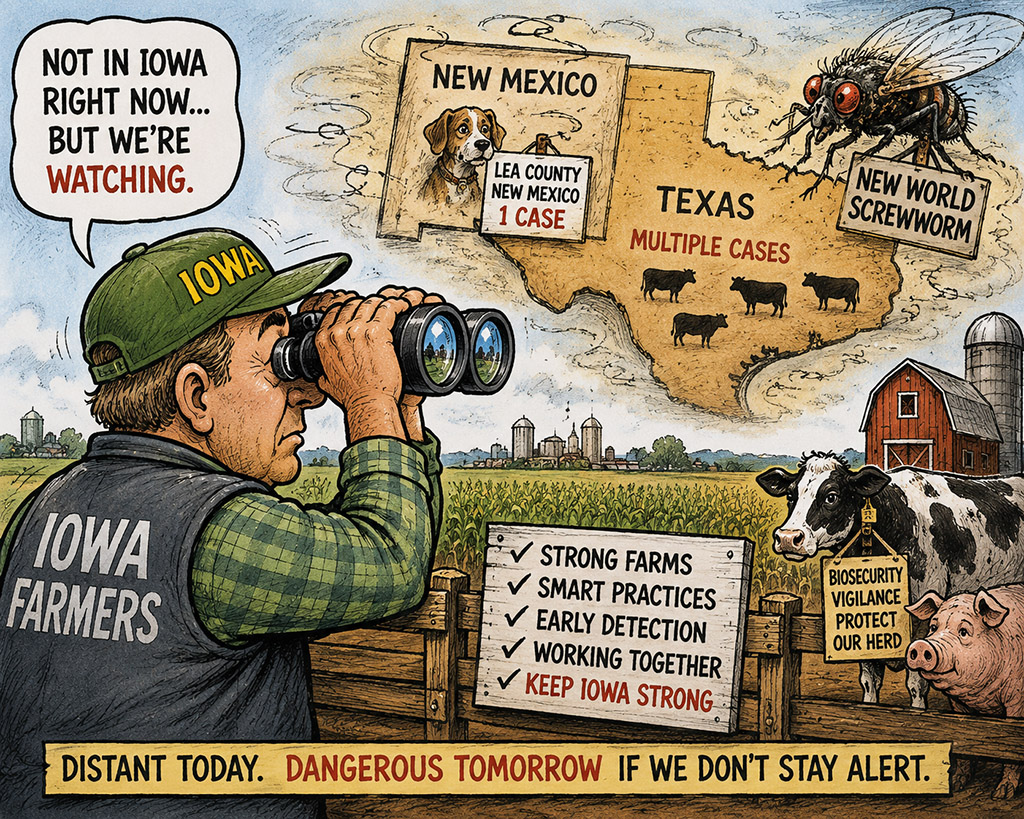
The recent detection of New World screwworm cases in Texas and New Mexico may seem like a distant concern for Iowa, but livestock producers and animal health officials are paying close attention.
The U.S. Department of Agriculture recently confirmed additional New World screwworm cases, including a goat in Texas and what is now classified as the first confirmed case in New Mexico after investigators determined an infected dog resided in Lea County, New Mexico, rather than neighboring Andrews County, Texas.
While officials continue to describe the New Mexico case as potentially isolated, the dog’s recent travel and exposure history remain unknown. As a result, federal and state authorities have expanded surveillance efforts, increased inspections of nearby animals, deployed fly traps, and are preparing for the possible release of sterile insects if needed to prevent further spread.
The response reflects the seriousness of the threat.
What Is New World Screwworm?
Unlike ordinary maggots that feed on dead tissue, New World screwworm larvae feed on living flesh. Female flies lay eggs in wounds or body openings, and the larvae burrow into healthy tissue, causing painful and potentially severe infestations.
The parasite can affect cattle, sheep, goats, horses, pets, and wildlife. In rare cases, humans can also become infected.
Without prompt treatment, infestations can lead to significant animal suffering, secondary infections, and even death.
Why Iowa Should Care
There are currently no known New World screwworm cases in Iowa.
However, Iowa is the nation’s leading pork-producing state and a major livestock producer. Animal health threats occurring hundreds of miles away can still have significant economic consequences if they spread or trigger new restrictions on livestock movement.
Agriculture depends on the safe movement of animals, strong surveillance systems, and rapid response when diseases or parasites are detected. That reality has already been demonstrated this year.
In May, Iowa officials responded to the state’s first commercial pseudorabies outbreak in more than two decades after infected pigs transported from Texas tested positive for the disease. State and federal officials quickly quarantined the operation, destroyed affected animals, and conducted extensive testing to prevent further spread.
While pseudorabies and screwworm are entirely different biological threats, both incidents highlight the importance of biosecurity and interstate animal health monitoring.
USDA Response Expands
Federal officials are treating screwworm detections seriously. According to USDA, response efforts currently include epidemiological investigations, sampling of additional animals, fly trapping, public outreach and reporting campaigns, and preparation for sterile insect releases if necessary.
The sterile insect technique was a key component of the successful campaign that eradicated New World screwworm from the United States decades ago.
Officials are also encouraging livestock owners and pet owners in affected areas to inspect animals daily for draining or enlarging wounds, maggots or egg masses, signs of irritation or discomfort, or lesions around ears, noses, genitals, or navels.
A Reminder About Agricultural Biosecurity
The growing number of detections in Texas and New Mexico does not mean Iowa faces an immediate threat. What it does demonstrate is that animal health threats remain a constant challenge in an interconnected agricultural economy.
Livestock diseases and parasites do not recognize state boundaries. Effective surveillance, rapid reporting, and coordinated responses are often the difference between a contained incident and a costly regional outbreak.
For now, Iowa producers can be encouraged that no cases have been detected in the state. But as federal and state officials continue investigating these cases in the Southwest, it is a situation worth watching closely. As recent events have shown, protecting Iowa agriculture often begins long before a threat reaches Iowa’s borders.
Breaking With Trump, or Just His Poll Numbers?
Candidates show some dissent over the Iran war, as Grassley and Ernst vote against limiting Trump’s war powersIowa Republican candidates are changing their positions on the Iran war as Election Day approaches. That is news. Calling it a “break with Trump” may be...
Has the UI Center Lost Its Academic Legitimacy?
How Much Academic Legitimacy Does Iowa's Center for Intellectual Freedom Have Left?Eleven scholars recruited to help establish the Center have resigned. Their departure raises a bigger question about what made this politically created institution academic in the first...
Trump Lost His Lawsuit. But Did the Lawsuit Fail?
An Iowa judge threw out Donald Trump’s lawsuit against Gannett and pollster J. Ann Selzer. But after nearly two years of litigation, the case raises a larger question about what it means to “win.”President Donald Trump lost his lawsuit against Gannett (owner of the...
As Iowans Suffer, Grassley Turns His Focus to Transgender Sports
Iowa already prohibits transgender girls from competing in girls' sports. With farmers struggling with diesel prices and families confronting inflation and housing costs, why is Chuck Grassley making the issue a national priority now?Should we be concerned about his...
Would a Ban of Diesel Exports Actually Lower Prices? Likely Not.
It’s More Complicated Than Grassley BelievesSen. Chuck Grassley says the U.S. should stop exporting diesel to bring down prices for farmers and truckers. The oil industry says that could backfire. Its explanation deserves a closer look.Iowa farmers are heading into...
Iowa Corn Growers Ask for Diesel Price Relief as Harvest Begins
Iowa Corn Growers Association asks for diesel relief as harvest kicks offBy Cami KoonsIowa Capital Dispatch As Iowa farmers begin harvesting their crops, corn growers in the state are asking Iowa congressional delegates to help lower the cost of diesel fuel, which has...
Mortgage Rates Hit 7% as War Increases Housing Market Pressure
Higher energy prices, persistent inflation, and rising borrowing costs are making an already difficult housing market even harder for buyers.The New York Times reports that mortgage rates have climbed above 7% for the first time since January 2025, another economic...