
Iowa Legislature and Regents Join Forces to Limit the State’s Higher Education Growth
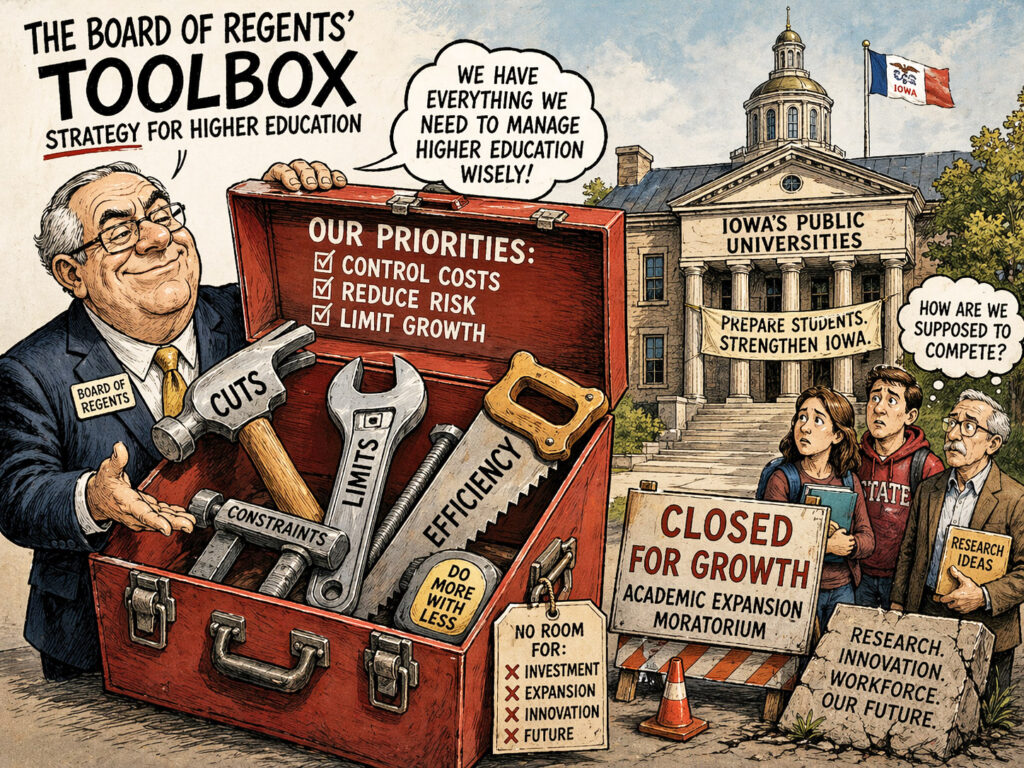
Policy by Constraint, Not Growth
A pattern emerging in Iowa raises a fundamental question. Are state leaders managing higher education… or quietly shrinking it?
Recent actions by the Iowa Legislature and the Board of Regents suggest a coordinated shift away from growth, investment, and institutional strength and toward constraint, limitation, and financial compression.
And it is happening in plain sight.
Exhibit A: Tuition “Guarantees” That Reduce Revenue
The Iowa Board of Regents is proposing an “optional tuition guarantee” program allowing select students to lock in tuition rates for four years. For a price.
On the surface, it sounds student-friendly by offering predictability, planning, and stability. But beneath that framing lies a different reality. Students must pay an upfront premium (10% of tuition), only certain student populations qualify, and universities will assume long-term revenue risk.
More importantly, state analysts have already projected the outcome. The proposal would amount to millions of lost revenue for universities, projected to be up to $6.7 million annually by 2031 under certain conditions.
And that’s just the pilot concept.
Separate legislative proposals go further, including a five-year tuition freeze that could cost universities $178 million in lost revenue. This is not cost control; it is revenue suppression.
Exhibit B: A Moratorium on Academic Growth
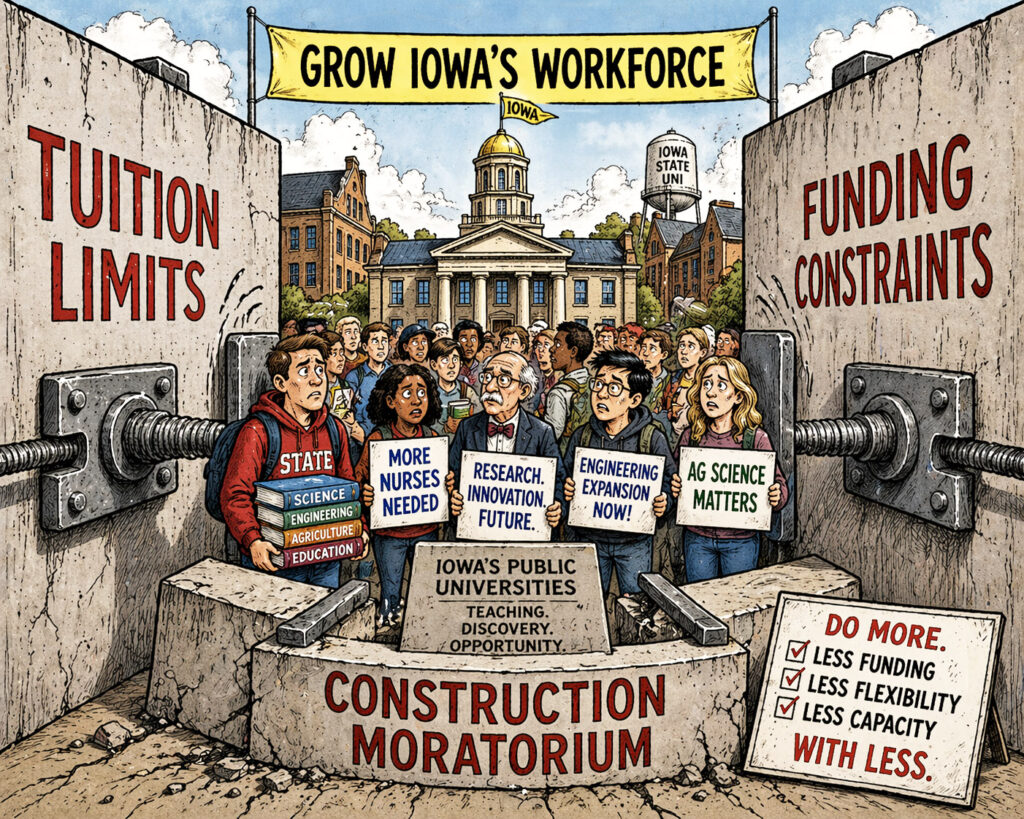
At the same time, the Board of Regents is considering a sweeping policy that would mean a halt to new academic buildings, expansion would be prohibited, and no growth in the academic space, for three years.
Under the proposed moratorium universities cannot add new instructional or research space, expansion is effectively frozen, and growth must come only through rearranging existing infrastructure. There are exceptions, but they are narrow, bureaucratic, and difficult to meet.
Meanwhile, university enrollment pressures are shifting, workforce demands (healthcare, engineering, agriculture) are increasing, and Iowa’s state universities are being asked to do more with less space and less funding.
This is not strategic planning. It is managed stagnation.
The Broader Pattern: Limit, Don’t Invest
These two policies, revenue constraints and physical growth limits, do not exist in isolation. They are part of a broader, multi-year trend in Iowa that includes flat or minimal state funding increases, political skepticism toward higher education institutions, pressure to prioritize “efficiency” over expansion, and a growing emphasis on cost control rather than capacity building.
At the same time, universities are asked to expand nursing programs, train more rural physicians, support agricultural innovation, and compete nationally for students and research funding. In other words, to produce more outcomes with fewer resources and fewer tools.
The Contradiction at the Core
The Iowa Board of Regents exists for a reason – to govern, support, and advocate for the state’s public universities. Yet current policy direction suggests something else.
Limiting tuition growth reduces financial flexibility. Limiting construction reduces academic capacity. And limiting funding will only reduce competitiveness.
Taken together, these are not neutral decisions. They are directional. And the direction is clear; contain the system, don’t grow it.
What This Means for Iowa
The long-term implications of the proposed incentives are not abstract, they are measurable. The initiatives would reduce universities’ ability to attract top faculty, result in fewer research initiatives and grants, limit program expansion in high-demand fields, increase a state disadvantage competition with other states, and result in enrollment stagnation and decline.
And perhaps most importantly, it will lead to a slower pipeline of skilled graduates entering Iowa’s workforce at a time when talent shortages are already a concern.
Final Observation
Individually, each of these policies can be explained. Together, they tell a different story. Not of reform or modernization, but of gradual contraction that is framed as efficiency.
And the question Iowa must answer is simple. Is this how support of Iowa’s higher education should look?
Breaking With Trump, or Just His Poll Numbers?
Candidates show some dissent over the Iran war, as Grassley and Ernst vote against limiting Trump’s war powersIowa Republican candidates are changing their positions on the Iran war as Election Day approaches. That is news. Calling it a “break with Trump” may be...
Has the UI Center Lost Its Academic Legitimacy?
How Much Academic Legitimacy Does Iowa's Center for Intellectual Freedom Have Left?Eleven scholars recruited to help establish the Center have resigned. Their departure raises a bigger question about what made this politically created institution academic in the first...
Trump Lost His Lawsuit. But Did the Lawsuit Fail?
An Iowa judge threw out Donald Trump’s lawsuit against Gannett and pollster J. Ann Selzer. But after nearly two years of litigation, the case raises a larger question about what it means to “win.”President Donald Trump lost his lawsuit against Gannett (owner of the...
As Iowans Suffer, Grassley Turns His Focus to Transgender Sports
Iowa already prohibits transgender girls from competing in girls' sports. With farmers struggling with diesel prices and families confronting inflation and housing costs, why is Chuck Grassley making the issue a national priority now?Should we be concerned about his...
Would a Ban of Diesel Exports Actually Lower Prices? Likely Not.
It’s More Complicated Than Grassley BelievesSen. Chuck Grassley says the U.S. should stop exporting diesel to bring down prices for farmers and truckers. The oil industry says that could backfire. Its explanation deserves a closer look.Iowa farmers are heading into...
Iowa Corn Growers Ask for Diesel Price Relief as Harvest Begins
Iowa Corn Growers Association asks for diesel relief as harvest kicks offBy Cami KoonsIowa Capital Dispatch As Iowa farmers begin harvesting their crops, corn growers in the state are asking Iowa congressional delegates to help lower the cost of diesel fuel, which has...
Mortgage Rates Hit 7% as War Increases Housing Market Pressure
Higher energy prices, persistent inflation, and rising borrowing costs are making an already difficult housing market even harder for buyers.The New York Times reports that mortgage rates have climbed above 7% for the first time since January 2025, another economic...