Old McDonald Had a Farm, AI AI Oh
How artificial intelligence is becoming the next tool in American agriculture
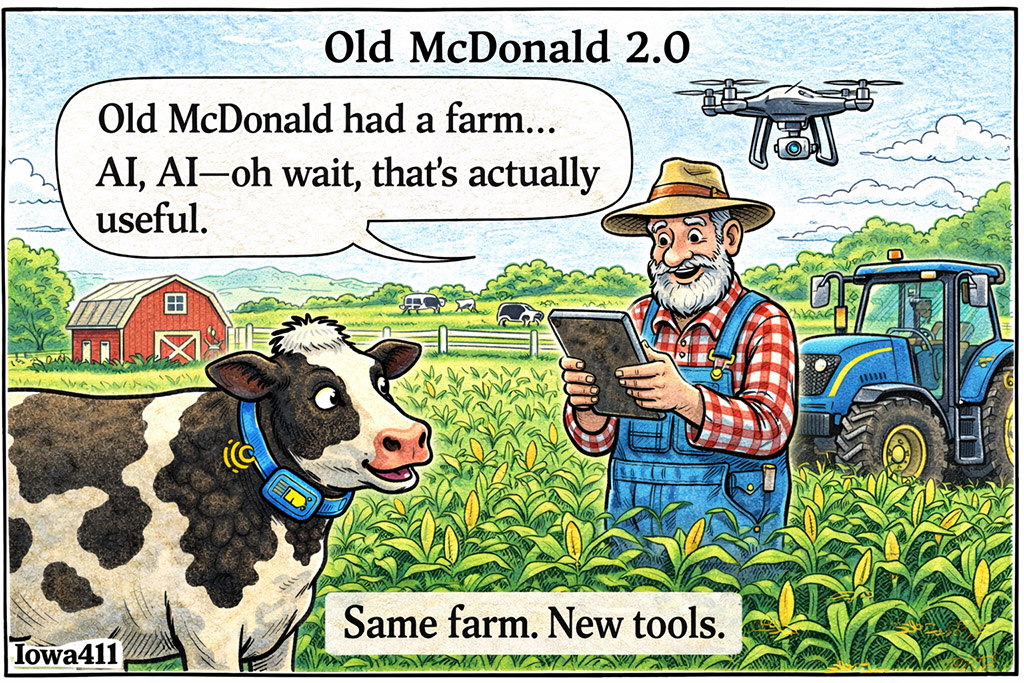
Old McDonald’s farm has come a long way. Today’s farms are already high-tech operations guided by GPS, powered by precision equipment, and supported by data that would have been unimaginable just a generation ago. Now, a new layer is emerging, artificial intelligence.
AI may prove as transformative to farm decision-making as tractors were to farm labor, adding a new layer of capability rather than replacing the tools that came before.
From Muscle to Mind
Tractors changed how farmers worked the land. They increased scale, reduced labor demands, and made it possible to do more with less physical effort.
AI is beginning to change something different: how farmers understand their land. Instead of replacing physical work, AI enhances decision-making to help farmers interpret conditions, anticipate risks, and respond more precisely to what’s happening in their fields and operations.
What AI Looks Like on the Farm
For many farmers, AI isn’t a futuristic concept, it’s already starting to show up in practical ways.
Crop Monitoring and Precision Agriculture
AI systems can analyze soil conditions, crop health, and satellite imagery to identify problems early—often before they are visible to the human eye. That allows for more targeted use of water, fertilizer, and inputs.
Weather and Risk Prediction
Weather has always been one of the biggest uncertainties in farming. AI tools can model localized weather patterns, helping farmers make better decisions about planting, harvesting, and protecting crops.
Livestock Health Monitoring
Sensors and AI-driven systems can track animal behavior, feeding patterns, and early signs of illness, allowing for faster intervention and better herd management.
Market Insights
AI can analyze commodity trends, input costs, and historical data to help farmers make more informed decisions about when to sell and how to manage financial risk.
Paperwork and Compliance
From USDA forms to grant applications, administrative work takes time. AI tools can assist with documentation, freeing up time for actual farm operations.
The Real Opportunity: Better Decisions
The common thread is not automation, it’s insight. AI gives farmers earlier warnings, better information, and more precise control.
In a business where margins can be tight and timing is everything, those advantages matter.
The Tension: Who Benefits?
As with any new technology, the benefits may not be evenly distributed. Larger operations often have more resources to adopt new tools quickly. Smaller and family farms may face barriers, including cost, access to technology, and concerns about data ownership.
That raises important questions. Will AI help level the playing field, or widen the gap? And will it support family farms, or accelerate consolidation?
These are not just technical questions. They are economic and community questions that will shape the future of rural America.
The Iowa Perspective
In Iowa, where agriculture is both an economic engine and a way of life, these questions carry weight.
Family farms remain central to many communities. At the same time, those farms face increasing pressure, from market volatility to labor challenges to rising input costs.
AI has the potential to help address some of those pressures by improving efficiency, reducing waste, and supporting better long-term planning. But adoption will depend on whether the technology is accessible, affordable, and aligned with the realities of farm life.
A Tool but Not a Replacement
It’s important to be clear about what AI is, and what it isn’t. AI is not replacing farmers. It is not replacing tractors, combines, or the experience that comes from working the land year after year.
It is becoming another tool. And like any tool, its value depends on how it is used.
Looking Ahead
Agriculture has always evolved, from hand labor to mechanization to precision farming. AI represents the next step in that evolution.
The challenge, and opportunity, will be ensuring that this next step strengthens the farms and communities that have long been the backbone of states like Iowa.
Because in the end, the goal is not just more efficient farming. It is farming that is sustainable economically, environmentally, and generationally. And if AI can help achieve that, then maybe Old McDonald’s farm still has a few new verses left to sing.
AI, AI oh.
What the Fundraising Reports Are Beginning to Tell Us
What the Candidate Fundraising Reports Are Beginning to Tell UsBeyond the Dollars: Emerging Fundraising Trends in Iowa's 2026 Elections A Look Into Early Iowa Campaign Financing Reports Every campaign finance reporting period produces a familiar set of headlines about...
Editorial: Beyond One Candidate, Election, and Lawsuit
Iowa judge to decide if Libertarian governor ticket will be on ballotAn Iowa411 EditorialWho Should Decide Ballot Access: Courts or Voters? In the coming days, a Polk County judge will decide whether Libertarian candidates Nicholas Gluba and Jules Cutler will appear...
What Fundraising Reports Reveal About the Iowa Governor’s Race
Beyond the Dollars: What Campaign Fundraising Reports Reveal About the Iowa Governor's RaceIowa Politics Analysis Campaign finance reports often produce a single headline about who raised the most money. This reporting period certainly did. Democratic gubernatorial...
Iowa Layoffs Hit One-Year High, Most Are Manufacturing Jobs
Iowa Layoffs Reach One-Year High as Manufacturing Sector Leads June Job LossesIowa Economy Brief Iowa employers announced 656 layoffs in June, the highest monthly total in a year, with manufacturing accounting for most of the job losses, according to Iowa's Worker...
Iowa Religious Leaders Gather to Support Voting Rights
Iowa Faith Leaders Gather to Support the Moral Issue of Our Time - Voting RightsFaith Gathering to Support Voting Rights Des Moines Register writer Isabelle Foland reported that religious leaders from across Iowa gathered in downtown Des Moines earlier this month to...
Reynolds’ Medicaid Task Force to Examine a Miniscule Problem
Reynolds Creates Medicaid Fraud Task Force as Iowa Reports One of Nation's Lowest Improper Payment RatesNew panel aims to eliminate fraud, waste and abuse while state already performs well below national average Gov. Kim Reynolds has created a new task force to combat...
As Opposition Grows, Iowa Continues to Recruit Data Centers
State actively markets Iowa to technology companies as communities debate costs and benefitsState actively markets Iowa to technology companies as communities debate costs and benefits As several proposed data center projects encounter growing local opposition, Iowa...