
State savings weaken as budget pressures increase, analysis warns
By Kevin Hardy
Iowa Capital Dispatch
State rainy day funds — money reserved to cover unexpected expenses and patch short-term budget holes — are declining nationally as states face increased costs, lower tax revenue and federal budget cuts, a new analysis found.
The decline follows a period of strong reserves bolstered by federal pandemic aid and higher-than-expected tax collections, the report said.
Researchers at The Pew Charitable Trusts found that the number of days that state reserves could cover state operations fell in fiscal year 2025 — the first decline since the Great Recession.
State reserve funds will play a critical role in stabilizing state finances as they confront the most widespread budgetary pressures since at least 2020, the researchers said. Like household savings accounts, state reserves help fund major one-time investments or provide a cushion in times of disrupted tax revenues, including economic downturns. Lower reserves means states could be quicker to cut state services or raise taxes in times of tight budgets.
Examining data from a survey conducted by the National Association of State Budget Officers, Pew researchers concluded that the median state in 2025 could fund its operations on reserve funds for 47.8 days — down from a record 54.5 days in fiscal 2024.
States last fiscal year held a collective $174 billion in savings, though reserves varied widely. Wyoming, for example, held enough cash on hand to operate for 320 days. But New Jersey’s reserve didn’t hold enough to cover a single day of state operations. The other states with the smallest share of rainy day reserves were Washington, Illinois, Delaware and Rhode Island.
The Pew analysis found that 26 states in 2025 had less capacity in their rainy day funds — meaning they would cover fewer days of state operations. In 14 of those states, officials drew on reserves, while 10 grew their balances but did so more slowly than they increased state spending. Two states maintained flat reserve levels as expenses grew.
While helpful in the short term, reserves won’t provide a long-term solution for states as many are confronting structural imbalances, meaning revenue streams are not keeping up with government spending.
“Although reserves exist to provide relief during times of fiscal stress, they are not a sustainable solution for persistent budget shortfalls,” the analysis said.
Budget pressures are expected to increase as states grapple with major federal policy changes that cut state funding and increase state administrative costs for federal safety net programs including Medicaid and food assistance.
In its most recent survey of state budgets, the National Association of State Budget Officers found that general fund spending was projected to be “nearly flat” in fiscal year 2026 budgets. More states last year began enacting spending cuts and hiring freezes to balance budgets, the survey found, and slow revenue growth was projected for a fourth consecutive year.
The survey showed 23 states expected spending to stay flat or decline in 2026, while 14 expected spending to grow by less than 5%. Seven states projected growth between 5% and 10%, while five expected spending to grow by more than 10%.
Stateline reporter Kevin Hardy can be reached at khardy@stateline.org.
This story was originally produced by Stateline, which is part of States Newsroom, a nonprofit news network which includes Iowa Capital Dispatch, and is supported by grants and a coalition of donors as a 501c(3) public charity. It was also published March 30 on the Iowa Capital Dispatch website. Iowa Capital Dispatch is part of States Newsroom, the nation’s largest state-focused nonprofit news organization.
Iowa dips into rainy-day funds
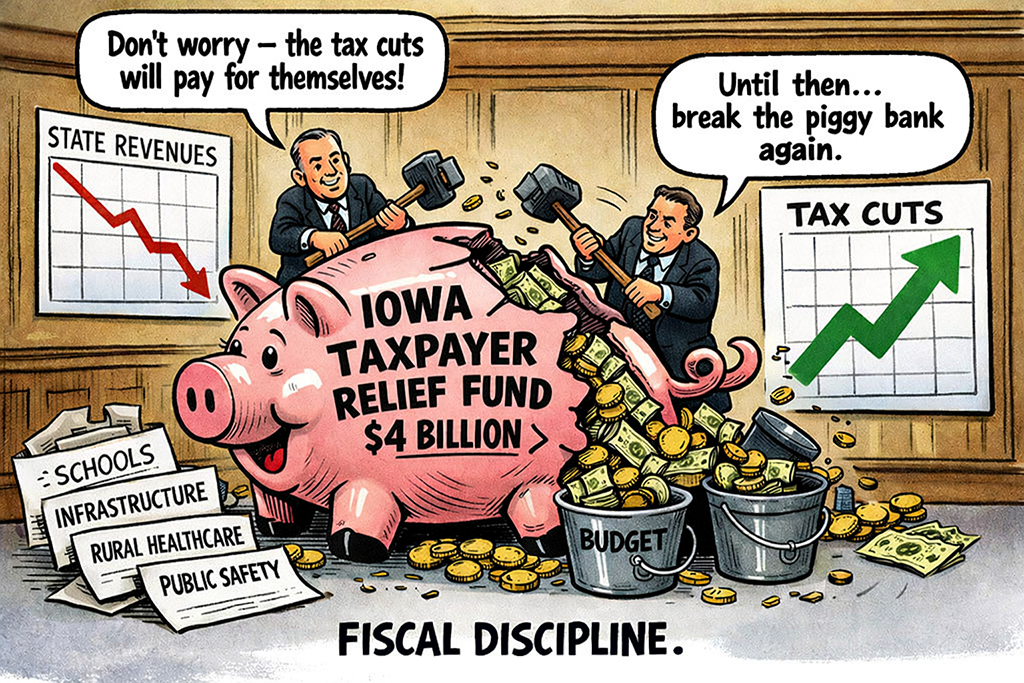
Facing a shortfall of revenue compared to spending for the second year in a row, Iowa Gov. Kim Reynolds and the GOP legislative majority moved this year to both raise a tax on health insurance premiums and borrow from the state’s rainy-day funds.
Reynolds on Thursday signed into law a one-time tax increase on health maintenance organizations, retroactive to Jan. 1, 2026, aimed at filling a $90.6 million deficit in Medicaid in fiscal year 2026 and a $167.6 million deficit in FY 2027. The bill also transfers almost $350 million from roughly $4 billion Iowa’s Taxpayer Relief Fund to make up for revenue loss from tax cuts made at the federal level in the “One Big Beautiful Bill” act.
The state is projected to spend $1.4 billion more than it takes in during the current fiscal year, which ends June 30, and the governor’s budget proposes to spend $1.2 billion more than projected state revenues for the upcoming fiscal year that begins July 1. Reynolds and Republicans say the shortfall was anticipated as a result of recent income-tax cuts.
Breaking With Trump, or Just His Poll Numbers?
Candidates show some dissent over the Iran war, as Grassley and Ernst vote against limiting Trump’s war powersIowa Republican candidates are changing their positions on the Iran war as Election Day approaches. That is news. Calling it a “break with Trump” may be...
Has the UI Center Lost Its Academic Legitimacy?
How Much Academic Legitimacy Does Iowa's Center for Intellectual Freedom Have Left?Eleven scholars recruited to help establish the Center have resigned. Their departure raises a bigger question about what made this politically created institution academic in the first...
Trump Lost His Lawsuit. But Did the Lawsuit Fail?
An Iowa judge threw out Donald Trump’s lawsuit against Gannett and pollster J. Ann Selzer. But after nearly two years of litigation, the case raises a larger question about what it means to “win.”President Donald Trump lost his lawsuit against Gannett (owner of the...
As Iowans Suffer, Grassley Turns His Focus to Transgender Sports
Iowa already prohibits transgender girls from competing in girls' sports. With farmers struggling with diesel prices and families confronting inflation and housing costs, why is Chuck Grassley making the issue a national priority now?Should we be concerned about his...
Would a Ban of Diesel Exports Actually Lower Prices? Likely Not.
It’s More Complicated Than Grassley BelievesSen. Chuck Grassley says the U.S. should stop exporting diesel to bring down prices for farmers and truckers. The oil industry says that could backfire. Its explanation deserves a closer look.Iowa farmers are heading into...
Iowa Corn Growers Ask for Diesel Price Relief as Harvest Begins
Iowa Corn Growers Association asks for diesel relief as harvest kicks offBy Cami KoonsIowa Capital Dispatch As Iowa farmers begin harvesting their crops, corn growers in the state are asking Iowa congressional delegates to help lower the cost of diesel fuel, which has...
Mortgage Rates Hit 7% as War Increases Housing Market Pressure
Higher energy prices, persistent inflation, and rising borrowing costs are making an already difficult housing market even harder for buyers.The New York Times reports that mortgage rates have climbed above 7% for the first time since January 2025, another economic...