Whirlpool Layoffs in Iowa Reveal the Economic Reality Behind Tariffs, Housing, and Manufacturing
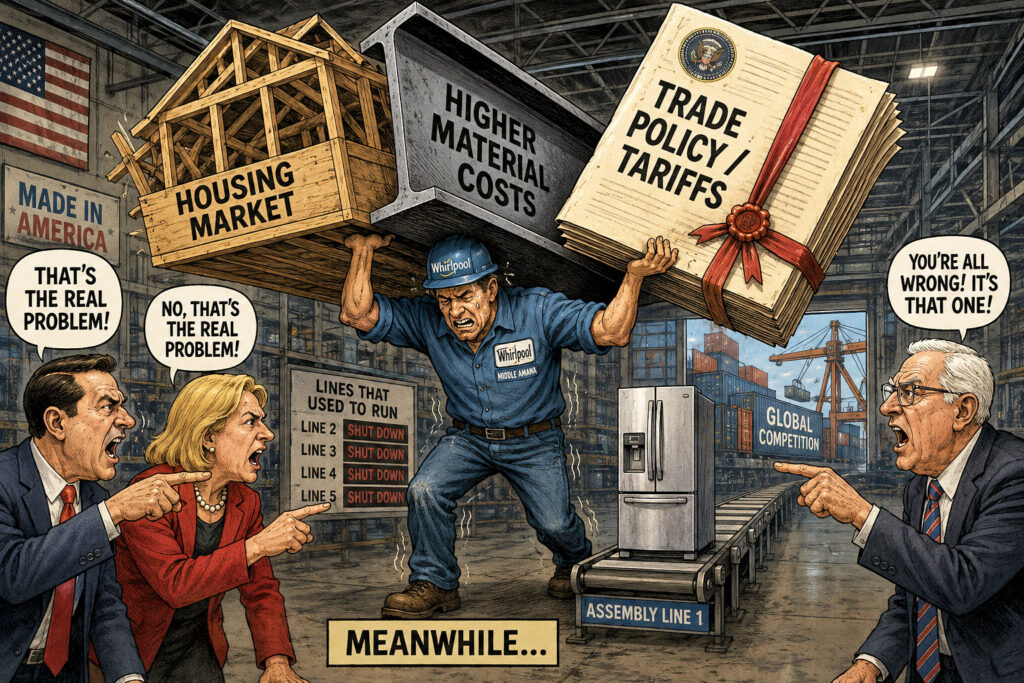
Tariffs, Housing, and Global Competition Collide in Iowa’s Whirlpool Setbacks
For years, politicians in both parties have promised to strengthen American manufacturing. President Donald Trump argued that tariffs would level the playing field by making imported goods more expensive and encouraging companies to build more products in the United States.
If there was one company expected to benefit from that strategy, it was Whirlpool.
A Reuters story reprinted this morning in the Des Moines Register notes that the Michigan-based appliance manufacturer produces roughly 80 percent of the products it sells in the United States from American factories, including its historic refrigerator plant in Middle Amana. Whirlpool CEO Marc Bitzer even described the company as a “net winner” from the administration’s trade policies.
Yet today, the Amana plant tells a different story. Only one refrigerator assembly line remains in operation, down from five just a few years ago. Another 288 Iowa workers are scheduled to lose their jobs this summer, reducing a workforce that once approached 2,000 employees by more than half.
The layoffs illustrate an important economic reality: tariffs alone cannot determine whether manufacturing jobs grow or disappear.
More than one economic story
It is tempting to view the Whirlpool layoffs as evidence that tariffs either succeeded or failed. The truth is more complicated.
Whirlpool itself says tariffs have helped narrow the price advantage enjoyed by foreign competitors and have increased the company’s confidence in investing in domestic manufacturing. The company has announced hundreds of millions of dollars in investments in its Ohio operations while also modernizing portions of its Iowa facility.
At the same time, those same tariffs have increased Whirlpool’s own costs for imported components and steel.
Meanwhile, another force has quietly become just as significant.
The housing market connection
Every new home needs appliances. When fewer homes are built, fewer kitchens are installed. When fewer kitchens are installed, demand for refrigerators declines.
That is precisely what has happened during one of the slowest housing markets in years.
Higher mortgage rates have reduced home construction, slowed remodeling projects, and weakened demand for large household appliances throughout the country. The result reaches far beyond homebuilders. It reaches the assembly lines in Middle Amana.
Global competition has not disappeared
Whirlpool also continues to compete against manufacturers operating in countries with lower labor costs.
While the company remains committed to building many products in the United States, it has continued sourcing components internationally and expanding certain operations elsewhere.
The company argues these decisions are part of a long-term modernization strategy rather than a retreat from American manufacturing. Workers understandably see something different when production continues shrinking.
Both perspectives can be true at the same time.
A political issue ahead of November
The layoffs have become an issue in Iowa’s closely watched First Congressional District race. Democratic candidate Christina Bohannan criticized the company’s decision and argued that “reckless, chaotic tariffs” are not rebuilding American manufacturing.
Representative Mariannette Miller-Meeks said she contacted Whirlpool leadership immediately after learning of the layoffs and later joined Representative Ashley Hinson in urging the company to preserve Iowa jobs.
Each campaign now argues it acted first. The larger political question, however, extends beyond campaign timing.
Can elected officials continue promising that trade policy alone will restore manufacturing employment if broader economic conditions continue moving in the opposite direction?
The human cost
Perhaps the most powerful part of the story comes from the workers themselves. Some voted for Donald Trump believing tariffs would help restore manufacturing employment.
Others have spent decades watching production steadily decline despite changing administrations, changing trade policies, and repeated promises.
In the Reuters story, one worker summarized the disappointment simply as “We thought we’d be getting our jobs back.” Whether one supports tariffs or opposes them, that sentence captures the human cost behind economic policy.
Manufacturing workers rarely experience economic issues one at a time. Housing markets, global competition, automation, modernization, interest rates, consumer confidence, supply chains, and trade policy all intersect on the factory floor.
For Iowa families in Middle Amana, those forces are no longer abstract economic theories.
They are paychecks.
Editorial: Whirlpool Layoffs, Responsibility, and Political Accountability
Breaking With Trump, or Just His Poll Numbers?
Candidates show some dissent over the Iran war, as Grassley and Ernst vote against limiting Trump’s war powersIowa Republican candidates are changing their positions on the Iran war as Election Day approaches. That is news. Calling it a “break with Trump” may be...
Has the UI Center Lost Its Academic Legitimacy?
How Much Academic Legitimacy Does Iowa's Center for Intellectual Freedom Have Left?Eleven scholars recruited to help establish the Center have resigned. Their departure raises a bigger question about what made this politically created institution academic in the first...
Trump Lost His Lawsuit. But Did the Lawsuit Fail?
An Iowa judge threw out Donald Trump’s lawsuit against Gannett and pollster J. Ann Selzer. But after nearly two years of litigation, the case raises a larger question about what it means to “win.”President Donald Trump lost his lawsuit against Gannett (owner of the...
As Iowans Suffer, Grassley Turns His Focus to Transgender Sports
Iowa already prohibits transgender girls from competing in girls' sports. With farmers struggling with diesel prices and families confronting inflation and housing costs, why is Chuck Grassley making the issue a national priority now?Should we be concerned about his...
Would a Ban of Diesel Exports Actually Lower Prices? Likely Not.
It’s More Complicated Than Grassley BelievesSen. Chuck Grassley says the U.S. should stop exporting diesel to bring down prices for farmers and truckers. The oil industry says that could backfire. Its explanation deserves a closer look.Iowa farmers are heading into...