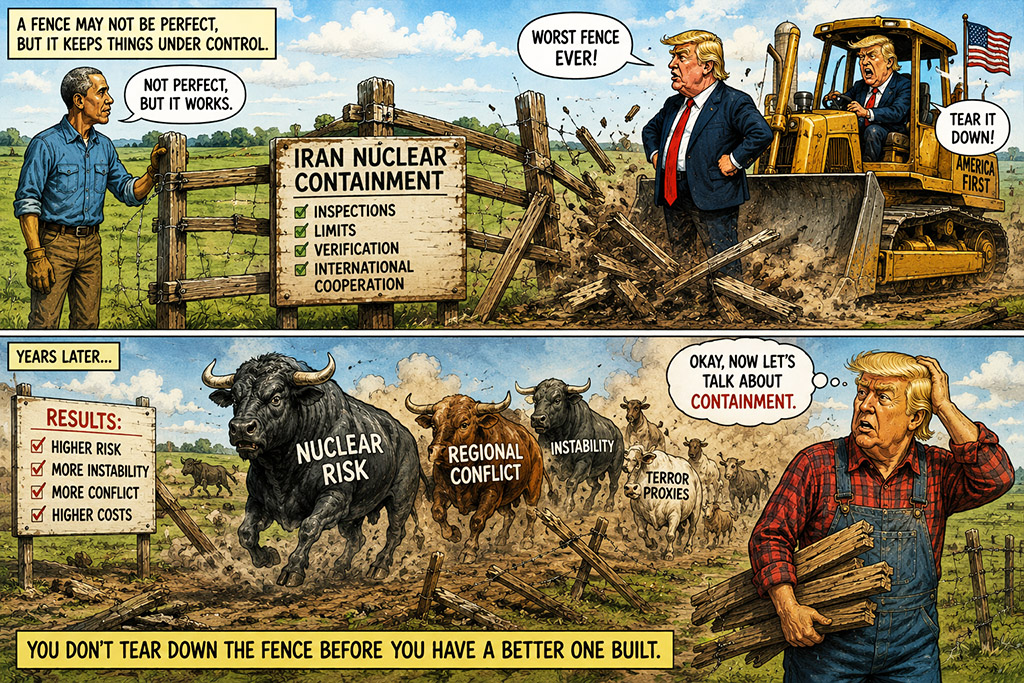
Was Iran Closer to a Nuclear Weapon Before or After the Deal Was Abandoned?
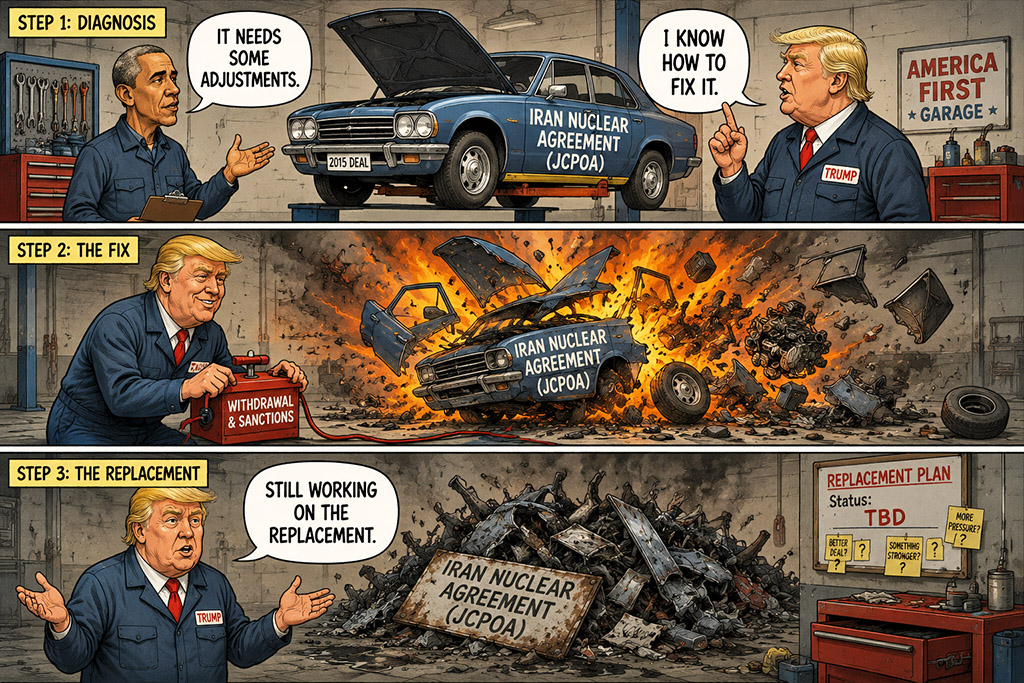
Was Iran Closer to a Nuclear Weapon Before or After the Deal Was Abandoned?
As tensions with Iran continue to dominate headlines, Americans are hearing a familiar claim.
President Donald Trump and Israeli Prime Minister Benjamin Netanyahu have repeatedly argued that the 2015 Iran nuclear agreement was a disaster and that Iran would have obtained a nuclear weapon if the agreement had remained in place.
It is a powerful argument. It is also a claim that deserves closer examination.
The question is not whether Iran is a friend of the United States. It is not. The Iranian government has supported proxy groups throughout the Middle East, threatened Israel, and often acts contrary to American interests.
The question is much narrower. Was Iran closer to obtaining a nuclear weapon while the agreement was in effect, or after it was abandoned?
That is a factual question. And it is one that often gets lost amid political rhetoric.
What Was the JCPOA?
The Joint Comprehensive Plan of Action, commonly known as the Iran nuclear deal, was negotiated between Iran, the United States, the United Kingdom, France, Germany, Russia, China, and the European Union.
The agreement took nearly two years to negotiate. Its purpose was straightforward, to prevent Iran from obtaining a nuclear weapon while allowing a peaceful civilian nuclear program under strict international oversight.
Iran agreed to reduce its enriched uranium stockpile by roughly 97 percent, remove thousands of centrifuges used to enrich uranium, limit uranium enrichment to low levels suitable for civilian purposes, redesign a reactor that could potentially produce weapons-grade plutonium, and accept some of the most extensive international inspections ever imposed on a nation’s nuclear program.
In exchange, economic sanctions were lifted. The deal was never intended to solve every problem involving Iran. It did not address missile programs. It did not end Iranian support for proxy groups. It did not transform Iran into a democracy.
Its purpose was far more limited. To prevent and monitor the development of a nuclear weapon.
What Did Inspectors Find?
This is the part often omitted from political speeches.
The International Atomic Energy Agency (IAEA), the independent organization responsible for monitoring nuclear activities, repeatedly reported that Iran was complying with the major provisions of the agreement.
Inspectors visited facilities, monitoring equipment remained in place, and inspectors declared nuclear sites were subject to ongoing verification.
That does not mean every concern disappeared. But it does mean that the international community had visibility into Iran’s nuclear program that it had not possessed before.
Why Did Critics Oppose the Deal?
The deal always had critics. Some argued that restrictions would eventually expire. Others believed sanctions relief strengthened the Iranian regime. And still others argued that Iran could not be trusted under any circumstances.
Those criticisms were not frivolous. Reasonable people could and did debate whether the agreement was strong enough.
But there is an important distinction between saying the deal had weaknesses and saying that the deal accomplished nothing. Those are very different claims.
What Happened After the U.S. Withdrawal?
In 2018, President Trump withdrew the United States from the agreement. The administration argued that the deal was fundamentally flawed and that greater pressure would produce a better outcome.
What happened next is largely undisputed. The inspection regime weakened, the agreement gradually collapsed, and Iran began increasing uranium enrichment. It expanded its stockpile of enriched uranium and installed additional centrifuges.
International concerns about Iran’s nuclear capabilities grew significantly.
In other words, Iran’s nuclear program became larger and less constrained after the agreement broke down than it had been while the agreement was operating. That does not prove the agreement was perfect. But it does raise an obvious question.
The Question That Matters
Imagine a homeowner worried that a neighbor might build a dangerous structure. A deal is reached. The neighbor gives up most of the building materials, accepts inspections, installs cameras, and agrees not to build beyond certain limits.
Inspectors repeatedly report compliance, then the agreement is canceled. The inspections stop and the monitoring ends. Then, the neighbor begins accumulating materials again.
Years later, someone points to the growing pile of materials and says “See? He was going to build it all along.”
A reasonable person might ask “Was the situation better while the inspections and restrictions were in place, or after they were removed? That is essentially the debate surrounding Iran.
The Bottom Line
The strongest criticism of the Iran nuclear agreement was never that it failed to restrict Iran’s nuclear program. It clearly did. The strongest criticism was that the restrictions were temporary, incomplete, or insufficient.
Those are legitimate arguments. But they are different from claiming the agreement accomplished nothing. The historical record suggests that Iran’s nuclear program was smaller, more heavily monitored, and more restricted while the agreement was in force than it became after the agreement collapsed.
Whether that means the deal should have been strengthened, renegotiated, or preserved is a matter for political debate. But before Americans accept sweeping claims about what might have happened, they should ask a simpler question.
“Was Iran farther from a nuclear weapon when inspectors were watching, or after the inspectors left?”
That question remains at the center of the debate, even if it is rarely asked.
Breaking With Trump, or Just His Poll Numbers?
Candidates show some dissent over the Iran war, as Grassley and Ernst vote against limiting Trump’s war powersIowa Republican candidates are changing their positions on the Iran war as Election Day approaches. That is news. Calling it a “break with Trump” may be...
Has the UI Center Lost Its Academic Legitimacy?
How Much Academic Legitimacy Does Iowa's Center for Intellectual Freedom Have Left?Eleven scholars recruited to help establish the Center have resigned. Their departure raises a bigger question about what made this politically created institution academic in the first...
Trump Lost His Lawsuit. But Did the Lawsuit Fail?
An Iowa judge threw out Donald Trump’s lawsuit against Gannett and pollster J. Ann Selzer. But after nearly two years of litigation, the case raises a larger question about what it means to “win.”President Donald Trump lost his lawsuit against Gannett (owner of the...
As Iowans Suffer, Grassley Turns His Focus to Transgender Sports
Iowa already prohibits transgender girls from competing in girls' sports. With farmers struggling with diesel prices and families confronting inflation and housing costs, why is Chuck Grassley making the issue a national priority now?Should we be concerned about his...
Would a Ban of Diesel Exports Actually Lower Prices? Likely Not.
It’s More Complicated Than Grassley BelievesSen. Chuck Grassley says the U.S. should stop exporting diesel to bring down prices for farmers and truckers. The oil industry says that could backfire. Its explanation deserves a closer look.Iowa farmers are heading into...
Iowa Corn Growers Ask for Diesel Price Relief as Harvest Begins
Iowa Corn Growers Association asks for diesel relief as harvest kicks offBy Cami KoonsIowa Capital Dispatch As Iowa farmers begin harvesting their crops, corn growers in the state are asking Iowa congressional delegates to help lower the cost of diesel fuel, which has...
Mortgage Rates Hit 7% as War Increases Housing Market Pressure
Higher energy prices, persistent inflation, and rising borrowing costs are making an already difficult housing market even harder for buyers.The New York Times reports that mortgage rates have climbed above 7% for the first time since January 2025, another economic...