
America’s K-Shaped Economy
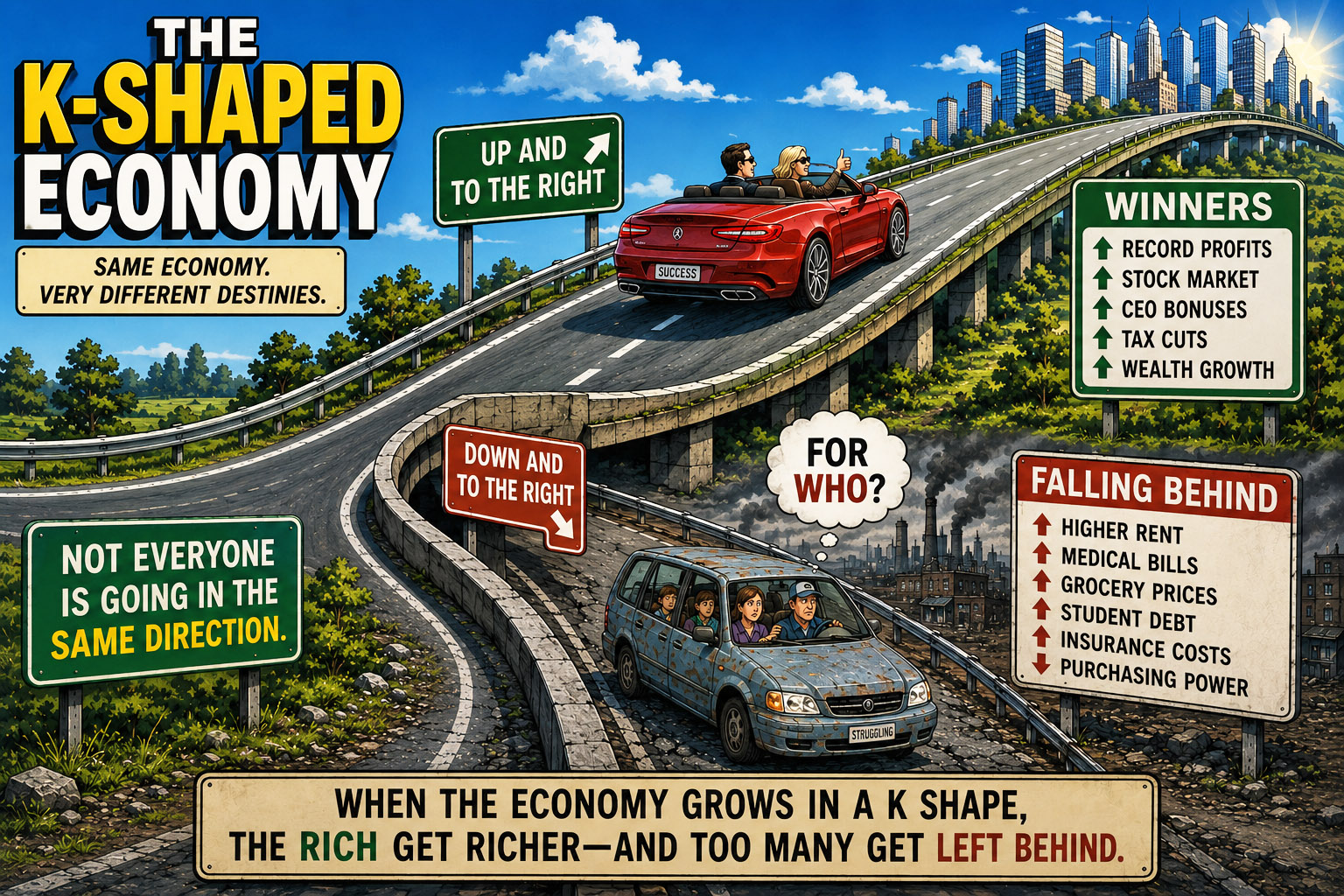
Understanding America’s “K-Shaped” Economy
If you listen to politicians, Wall Street analysts, or national economic reports, you might think the American economy is doing just fine.
Stock markets rise. Corporate profits grow. Wealthy Americans continue buying homes, investing money, traveling, and spending freely. Unemployment numbers may even look relatively stable on paper.
But for many middle-class and working-class Americans, including many Iowans, the economy often feels very different. That disconnect is one reason economists and analysts increasingly talk about America becoming a “K-shaped” economy.
What Is a K-Shaped Economy?
The term comes from the shape of the letter “K.” In a traditional economic recovery, most groups tend to improve together over time. But in a K-shaped economy, one group moves upward while another moves downward.
The upper part of the “K” represents Americans whose wealth, income, and opportunities continue growing. This includes wealthy households, investors, large corporations, highly paid professionals, and people who already own significant assets such as stocks or real estate.
The lower part of the “K” represents Americans facing rising financial pressure, including working-class families, many rural communities, lower-income households, young adults, seniors on fixed incomes, and portions of the traditional middle class.
In other words, the economy may be growing overall while many Americans continue struggling financially.
Why It Can Create a False Impression
One reason K-shaped economies are politically powerful is that they can make national economic conditions appear stronger than what many ordinary Americans experience in daily life.
For example, rising stock markets mainly benefit people who own substantial investments, strong corporate earnings primarily help large shareholders and executives, and increases in home values mostly help people who already own homes.
Meanwhile, many Americans may still face rising grocery costs, higher rent, expensive healthcare, growing insurance costs, unaffordable childcare, student debt, and wages that fail to keep up with inflation.
This creates a situation where economic headlines sound positive while many families feel like they are falling behind.
How It Reshapes the Middle Class
Over time, a K-shaped economy can slowly reshape the structure of American society itself.
Historically, the American middle class was built around stable employment, affordable housing, rising wages, strong local businesses, and the belief that each generation would do better than the one before it.
But as wealth becomes increasingly concentrated at the top, many middle-class Americans begin facing greater financial instability. Families may work longer hours while accumulating less savings. Younger generations may struggle to buy homes or start families. Rural communities may lose businesses, healthcare services, or population.
The result is a widening divide between Americans who benefit from economic growth and Americans who mainly absorb its costs.
Why Rural States Like Iowa Feel It Strongly
States like Iowa can experience the effects of a K-shaped economy very directly. Large corporations and investors may continue doing well while smaller towns struggle with hospital closures, workforce shortages, housing pressures, declining local businesses, and reduced economic opportunity for younger residents.
Meanwhile, many rural families increasingly depend on healthcare programs, public schools, infrastructure, and community services that face ongoing budget pressures. This can leave communities feeling economically insecure even when national leaders insist the economy is strong.
More Than Just Economics
A K-shaped economy does not only affect bank accounts. It also affects community stability, public trust, political frustration, family formation, healthcare access, and long-term optimism about the future.
When large portions of the population feel disconnected from economic growth, social and political divisions often deepen as well.
That is why many economists believe the long-term health of the country depends not simply on economic growth itself, but on whether ordinary Americans are able to meaningfully participate in that growth.
Breaking With Trump, or Just His Poll Numbers?
Candidates show some dissent over the Iran war, as Grassley and Ernst vote against limiting Trump’s war powersIowa Republican candidates are changing their positions on the Iran war as Election Day approaches. That is news. Calling it a “break with Trump” may be...
Has the UI Center Lost Its Academic Legitimacy?
How Much Academic Legitimacy Does Iowa's Center for Intellectual Freedom Have Left?Eleven scholars recruited to help establish the Center have resigned. Their departure raises a bigger question about what made this politically created institution academic in the first...
Trump Lost His Lawsuit. But Did the Lawsuit Fail?
An Iowa judge threw out Donald Trump’s lawsuit against Gannett and pollster J. Ann Selzer. But after nearly two years of litigation, the case raises a larger question about what it means to “win.”President Donald Trump lost his lawsuit against Gannett (owner of the...
As Iowans Suffer, Grassley Turns His Focus to Transgender Sports
Iowa already prohibits transgender girls from competing in girls' sports. With farmers struggling with diesel prices and families confronting inflation and housing costs, why is Chuck Grassley making the issue a national priority now?Should we be concerned about his...
Would a Ban of Diesel Exports Actually Lower Prices? Likely Not.
It’s More Complicated Than Grassley BelievesSen. Chuck Grassley says the U.S. should stop exporting diesel to bring down prices for farmers and truckers. The oil industry says that could backfire. Its explanation deserves a closer look.Iowa farmers are heading into...
Iowa Corn Growers Ask for Diesel Price Relief as Harvest Begins
Iowa Corn Growers Association asks for diesel relief as harvest kicks offBy Cami KoonsIowa Capital Dispatch As Iowa farmers begin harvesting their crops, corn growers in the state are asking Iowa congressional delegates to help lower the cost of diesel fuel, which has...
Mortgage Rates Hit 7% as War Increases Housing Market Pressure
Higher energy prices, persistent inflation, and rising borrowing costs are making an already difficult housing market even harder for buyers.The New York Times reports that mortgage rates have climbed above 7% for the first time since January 2025, another economic...