
Lawsuit Alleges that USDA Violated Federal Law by Applying New Restrictions to Projects
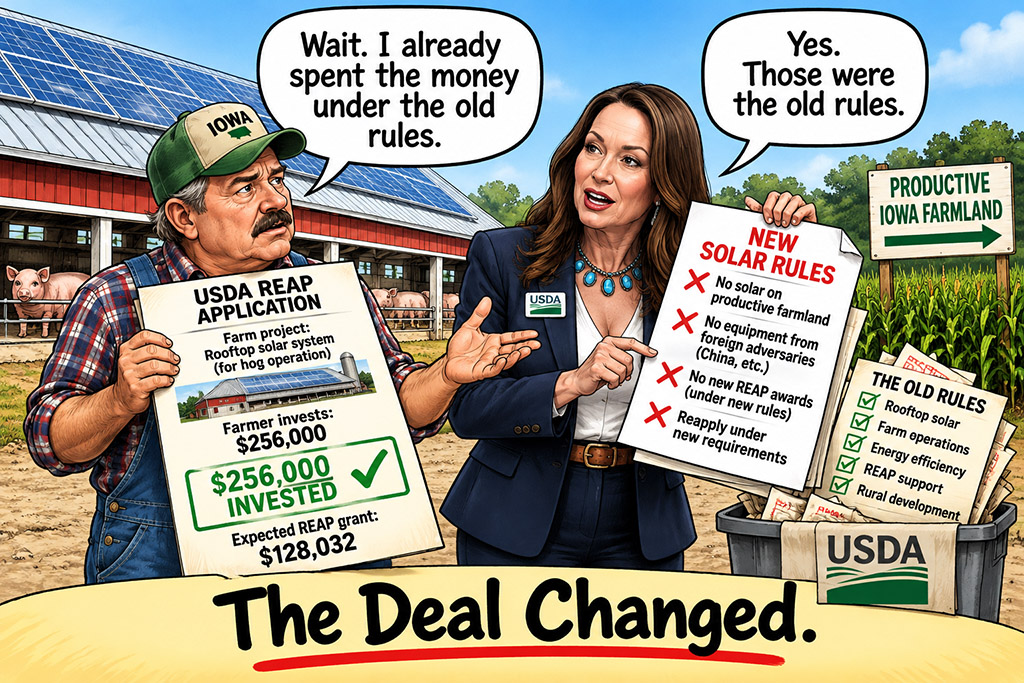
Iowa farmers invested in solar projects expecting federal assistance. Then USDA changed the rules. Now they want a court to make the government honor its commitments.
Iowa farmers who invested in solar energy with the expectation of federal assistance are taking the U.S. Department of Agriculture to court.
The Iowa Farmers Union and Iowa Solar Energy Trade Association are among the plaintiffs in a federal lawsuit filed September 28 challenging changes to the USDA’s Rural Energy for America Program or REAP.
Their argument is straightforward. Farmers followed the government’s rules, invested their own money in qualifying projects and expected USDA to provide the assistance available under the program. Then the Trump administration changed the rules, and some farmers were left holding the bill.
The lawsuit alleges USDA violated federal law by applying new restrictions to projects and applications that had proceeded under the earlier rules. It asks the court to invalidate the new policies and require USDA to process affected applications under the rules that existed when they were submitted. Those claims have not yet been decided by the court.
This wasn’t a new Biden program
REAP has existed since 2002 and was created to help agricultural producers and rural small businesses invest in renewable-energy systems and energy-efficiency improvements. The Inflation Reduction Act dramatically expanded it, providing more than $2 billion through 2031 and increasing the federal share for some qualifying projects to as much as 50%.
Solar became a major part of the program. According to the lawsuit, solar accounted for 68% of REAP awards between 2011 and the first quarter of 2025.
That began changing under the Trump administration.
In August 2025, Agriculture Secretary Brooke Rollins announced that USDA would restrict support for solar projects on productive farmland and would not allow USDA-funded projects to use solar panels manufactured by designated foreign adversaries. The restrictions included limits on some ground-mounted solar systems larger than 50 kilowatts.
China is included in the foreign-adversary restriction, an important provision because China dominates global solar manufacturing.
USDA also argued that subsidized solar projects were consuming productive farmland, making farmland more expensive and reducing its availability to farmers. But that broad rationale doesn’t necessarily describe the projects at the center of the Iowa dispute.
Solar panels aren’t necessarily replacing cornfields
Iowa farmers have used REAP funding for rooftop solar and installations serving hog operations, grain dryers and other agricultural facilities. Those systems can reduce the electricity costs of running farms rather than replace farming with utility-scale solar development.
And USDA’s own research complicates the scale of the farmland argument. A 2024 USDA study found that utility-scale wind and solar facilities directly affected approximately 424,000 acres in 2020. Less than 0.05% of the nation’s roughly 897 million acres of farmland.
That doesn’t mean there are no legitimate questions about putting large solar installations on productive agricultural land. It does mean that a national concern about conversion of farmland doesn’t by itself explain why a farmer who put solar panels on an agricultural operation should lose funding expected under previously existing rules.
One Iowa farmer was expecting more than $128,000
The consequences aren’t theoretical. According to the lawsuit, Iowa Farmers Union member Ed Heishman, who grows corn and soybeans and raises hogs, invested about $256,000 in a 139-kilowatt rooftop solar system after applying for REAP assistance. His expected REAP award was $128,032.
USDA later declined to process the funding application under its changed policy, according to the complaint.
Other Iowa Farmers Union members have been affected as well. Union President Aaron Lehman said members who committed to renewable-energy projects feel “betrayed” by the changes. Iowa received more than $26 million in REAP investments covering more than 200 projects during fiscal years 2025 and 2026.
The administration went further in March 2026. USDA announced that it would make no additional REAP grant awards until new regulations were adopted. Applicants without fully executed financial-assistance agreements would have to apply again under the new rules.
The larger question isn’t solar
USDA is entitled to argue for a different renewable-energy policy. Congress and the administration can debate whether taxpayers should subsidize solar projects, where those projects should be located and whether federal dollars should purchase equipment manufactured in China.
But the Iowa lawsuit raises a different question. What happens when farmers make substantial financial decisions based on the rules the federal government gave them, and the government changes those rules after the money has been spent?
That’s why this case extends beyond the debate over solar energy. Farmers routinely make long-term decisions based on federal programs, whether involving conservation, crop insurance, disaster assistance, renewable energy or agricultural development. Those programs work only if producers can reasonably rely on the government’s commitments when deciding whether to invest their own money.
The Iowa Farmers Union isn’t asking the court to settle America’s argument over renewable energy. It is asking the court to decide whether USDA can change the deal after farmers have already kept their end of it.
Fool Us Once, Mr. President, Shame On You
Fool Us 13 Times, Shame on UsThere’s an old saying: Fool me once, shame on you. Fool me twice, shame on me. Add 11 more times Iowans were fooled by Donald Trump, and you have the latest Trump promise of the world's biggest steel mill that many feel is nothing more...
Before Iowa Bets On a Steel Mill, First Think About Foxconn
The Proposed Iowa Steel Mill: Lessons from Wisconsin’s Foxconn FailureWisconsin's failed $10 billion manufacturing promise offers lessons as Iowa considers incentives for a proposed $15 billion steel mill.A Wisconsin reader's letter to the Des Moines Register this...
The $1.5 Billion Question: Why the Rush to Subsidize?
Reynolds’ Timing to Dedicate Taxpayer Funds for the Mesabi Steel Mill Is QuestionedTrump's commerce secretary says the deal is done. So why are Iowa lawmakers being called back to offer hundreds of millions more in tax incentives?Iowa's proposed $15 billion steel mill...
The Hook: How Trump Benefits from False Claims
The Trump Tactic for Avoiding Questions about His Big LiesThe $15 billion Iowa steel mill may become everything Trump says it will. But his announcement illustrates a political technique Iowans have seen before: make the promise enormous, collect the political benefit...
Trump Announces $15 Billion Steel Mill for Southeast Iowa
Suspicions raised due to lack of details, timing of announcementThe massive project could bring thousands of jobs and make Iowa a major U.S. steel producer. But production isn't expected until 2030, and important questions about financing, incentives, environmental...
Iowa Legislators at Odds Over the Iran War
Hinson Calls for End to Iran War as Grassley and Ernst Vote to Continue ItIowa Republican Rep. Ashley Hinson is now calling for an “immediate end” to the nearly seven-month Iran war, even as Iowa Republican Sens. Chuck Grassley and Joni Ernst voted Thursday against a...
Breaking With Trump, or Just His Poll Numbers?
Candidates show some dissent over the Iran war, as Grassley and Ernst vote against limiting Trump’s war powersIowa Republican candidates are changing their positions on the Iran war as Election Day approaches. That is news. Calling it a “break with Trump” may be...