
What Trump’s Red-Dye Diesel Executive Order Actually Does
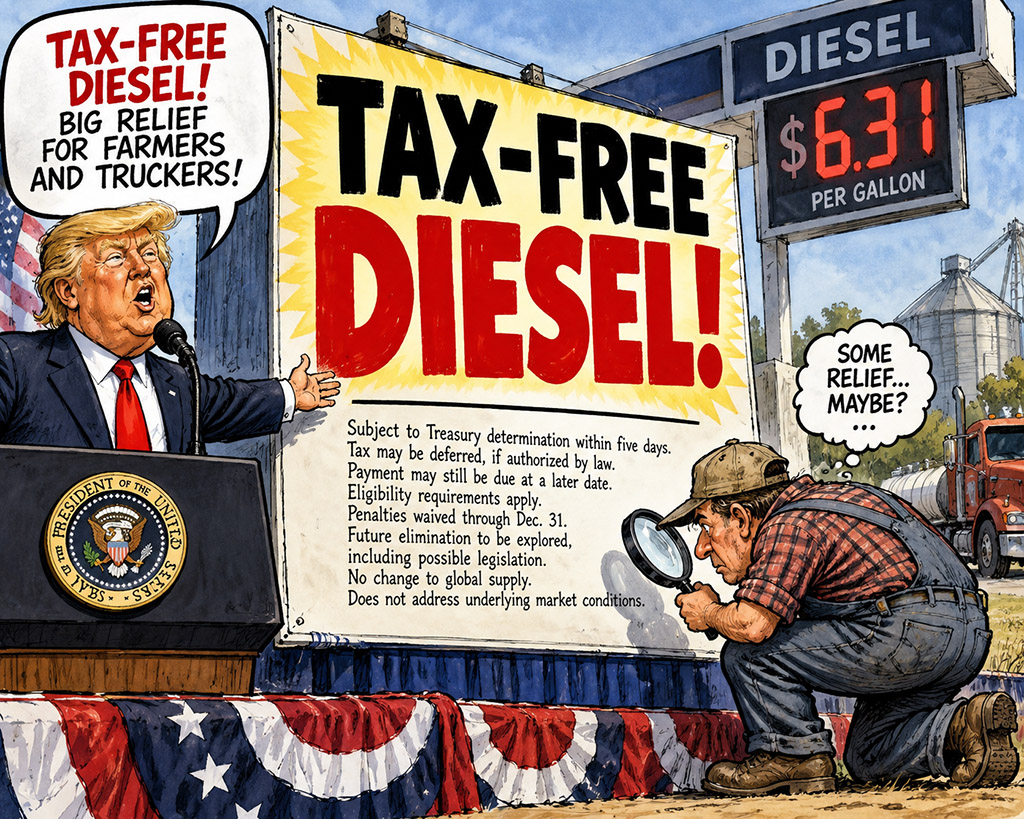
Trump promised “tax-free” diesel for farmers and truckers. His executive order actually directs Treasury to determine whether it can defer the tax while the forces driving record diesel prices remain largely untouched.
President Donald Trump went to Nebraska Monday night with what sounded like a straightforward answer to soaring diesel prices: let farmers and truckers use tax-free, red-dyed diesel on the highway.
“Tonight, I am going to sign a historic Executive Order to officially waive the off-road requirement and allow anyone to purchase tax-free red dye diesel for any reason,” Trump said.
The White House followed with an equally emphatic announcement, calling it “decisive action” that would immediately cut diesel costs. The administration says the change could save about $60 on a 250-gallon fill from the federal tax alone, and more than $100 where states provide corresponding relief.
There is just one problem. That isn’t quite what Trump’s executive order does.
What the order actually says
The federal excise tax on highway diesel is 24.4 cents per gallon. Red-dyed diesel normally avoids that tax because it is intended for off-road uses such as farming and construction. Trump’s order does immediately direct the IRS not to impose certain penalties for highway use of dyed diesel through Dec. 31. But when it comes to the tax itself, the language is considerably more conditional.
The order gives the Treasury secretary five days to determine whether existing law authorizes the administration to provide the proposed relief and which taxpayers would qualify. If Treasury makes those determinations, it is directed to defer payment of the applicable taxes, without penalties or interest, to the extent allowed by law.
And “defer” is important. The executive order does not simply erase the federal tax. In fact, it specifically directs Treasury to issue guidance identifying “the date by which postponed taxes must be paid.” A separate section directs Treasury to explore ways to eventually eliminate that obligation, including through legislation.
So, the distinction is significant. Trump announced tax-free diesel. His executive order directs the government to determine whether it can defer the tax and then explore how the deferred tax might ultimately be forgiven.
That is considerably more complicated than the headline.
And then there is the price of diesel
Even if the full federal tax ultimately disappears, another problem remains. That is, the tax isn’t what caused diesel to climb above $6 a gallon.
The White House itself acknowledges that. The opening section of Trump’s executive order says that “restricted global diesel supply has led to rising prices.” Its accompanying announcement also cites tightened global supply and insufficient refining capacity.
Current energy-market data point in the same direction. The U.S. Energy Information Administration has raised its oil-price forecasts as global inventories decline and diesel markets remain tight. War-related disruptions in the Middle East and attacks affecting Russian energy infrastructure have further strained supplies and refining capacity.
In other words, changing the tax treatment of a gallon of diesel can make that gallon cheaper for an eligible buyer. It doesn’t create another gallon of diesel.
That doesn’t mean the relief is meaningless. Twenty-four cents a gallon adds up for farmers and truckers consuming thousands of gallons of fuel, particularly during harvest. Expanding access to dyed diesel may also give users additional flexibility at a time when supplies are tight. But it is temporary financial relief, not a solution to the conditions responsible for today’s diesel prices.
The hook
That distinction gets lost in an announcement built for a headline of Tax-free diesel for farmers and truckers. It is simple. It is tangible. And with diesel prices hovering around $6 a gallon just weeks before the midterm elections, it gives the administration something highly visible to point to.
The timing is difficult to separate from the politics. Trump announced the policy during a Nebraska campaign stop as Republicans confront voter dissatisfaction over fuel prices and the broader cost of living ahead of the Nov. 3 election.
There was also an unusual moment during Trump’s explanation of the policy. While introducing red-dyed diesel to the audience, Trump acknowledged that he did not know what it was before continuing with the explanation of what his order was intended to accomplish. That matters less as a verbal stumble than as a window into the announcement itself.
The policy was being presented as a major presidential response to diesel prices even as its central mechanism required explanation, and even as the executive order Trump signed was more conditional than his description of it.
Relief is not the same as a solution
Farmers and truckers have legitimate reason to welcome any reduction in their fuel costs. At today’s prices, even temporary tax relief matters. But evaluating an economic policy requires separating what was announced from what was actually ordered, and what the policy can accomplish from what the headline suggests it accomplished.
Trump’s red-diesel order may provide temporary relief. Treasury may determine that the taxes can be deferred. Congress or the administration may eventually find a way to forgive them altogether. None of those things changes the fundamental economics currently driving diesel prices.
The White House itself says global diesel supply is restricted. That is the problem. Red dye is the hook.
Texas City Charges $2 Million for Access to Flock Information
Texas city charges $2 million for Flock records as agencies make it harder to see how cameras are usedHigh invoices and challenges to accessing data on how departments use the surveillance cameras have hindered requests by privacy advocates and journalists.by Ayden...
Iowa Steel Mill Tax Credits: Where the Money Really Goes
Iowa Legislature’s Steel Mill Incentive Is More Than a Tax BreakIowa’s proposed steel mill incentives involve more than simply allowing Mesabi Metallics to pay less in taxes. Because the investment tax credits can be refundable or transferable, they can have financial...
Iowa Farmers Sue USDA Over Canceled Solar Funding
Lawsuit Alleges that USDA Violated Federal Law by Applying New Restrictions to Projects Iowa farmers invested in solar projects expecting federal assistance. Then USDA changed the rules. Now they want a court to make the government honor its commitments.Iowa...
Fool Us Once, Mr. President, Shame On You
Fool Us 13 Times, Shame on UsThere’s an old saying: Fool me once, shame on you. Fool me twice, shame on me. Add 11 more times Iowans were fooled by Donald Trump, and you have the latest Trump promise of the world's biggest steel mill that many feel is nothing more...
Before Iowa Bets On a Steel Mill, First Think About Foxconn
The Proposed Iowa Steel Mill: Lessons from Wisconsin’s Foxconn FailureWisconsin's failed $10 billion manufacturing promise offers lessons as Iowa considers incentives for a proposed $15 billion steel mill.A Wisconsin reader's letter to the Des Moines Register this...
The $1.5 Billion Question: Why the Rush to Subsidize?
Reynolds’ Timing to Dedicate Taxpayer Funds for the Mesabi Steel Mill Is QuestionedTrump's commerce secretary says the deal is done. So why are Iowa lawmakers being called back to offer hundreds of millions more in tax incentives?Iowa's proposed $15 billion steel mill...
The Hook: How Trump Benefits from False Claims
The Trump Tactic for Avoiding Questions about His Big LiesThe $15 billion Iowa steel mill may become everything Trump says it will. But his announcement illustrates a political technique Iowans have seen before: make the promise enormous, collect the political benefit...