
Iowa Chooses More Restrictive Food and Health Benefit Rules for Immigrants and Refugees
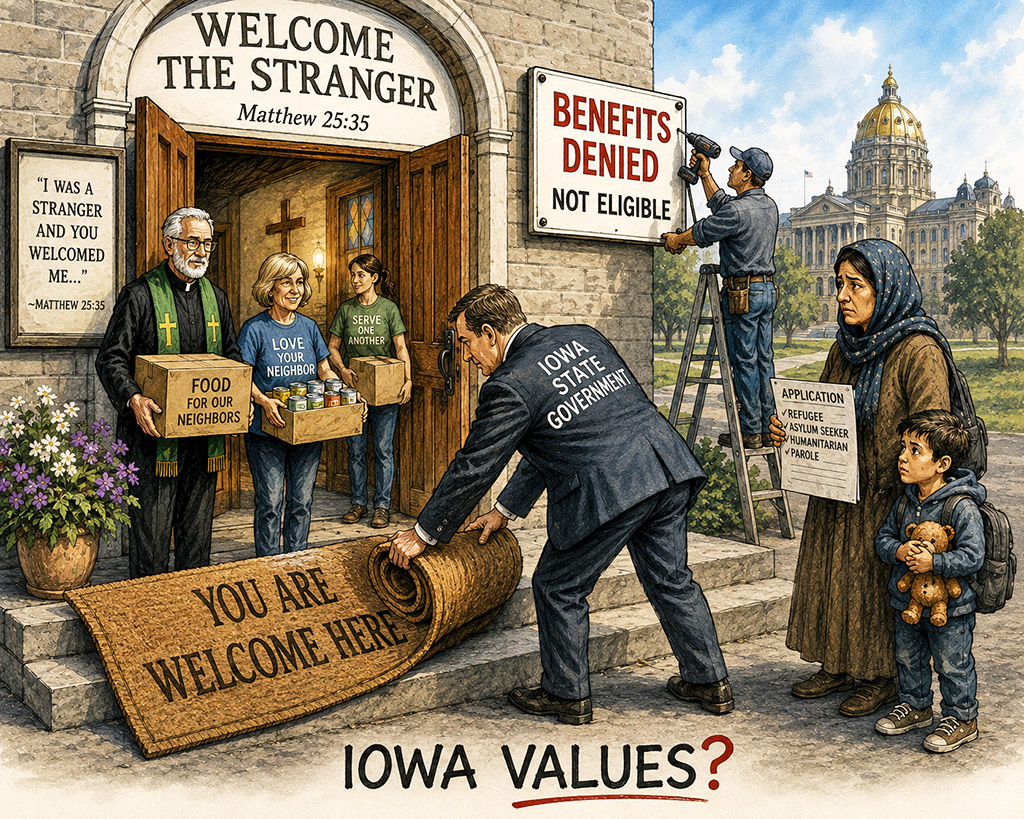
Iowa joins federal law in blocking immigrants from SNAP benefits
Governor Kim Reynolds recently signed legislation aligning Iowa law with several provisions of the federal budget package known as the “One Big Beautiful Bill.” Supporters describe the measure as a common-sense effort to control costs, reduce errors, and ensure that taxpayer-funded benefits are directed toward those lawmakers who believe should receive them.
Critics see something else. They see a state choosing to make life more difficult for some of its most vulnerable residents.
The new law affects eligibility for food assistance and health-care benefits. Among those affected are undocumented immigrants, but also refugees, asylees, and people admitted under humanitarian parole programs. The law also reduces certain periods of retroactive Medicaid eligibility and seeks additional restrictions on benefit availability.
Reasonable people can disagree about the details. Taxpayer-funded programs have costs. Governments have responsibilities. Citizens have every right to ask whether public dollars are being spent wisely. But policy discussions should not end there, they should also include the people affected by those decisions. Lost amid much of the political debate is the reality that many of those affected are not political symbols or talking points.
Many are children. Some are members of families fleeing violence, persecution, or instability. Some arrived through legal humanitarian programs established by the federal government. Some have parents working in Iowa communities, schools, farms, factories, and businesses.
Whatever one believes about immigration policy, children do not choose where they are born, where they live, or how they arrive. They simply need food and medical care. That reality raises questions that go beyond budgets and politics. For many Iowans, it also raises questions of faith.
Iowa remains a state where many elected officials speak openly about Christian values. Churches remain central institutions in countless communities. Faith-based organizations feed the hungry, support refugees, operate food pantries, and aid families in crisis every day. The teachings most often associated with Jesus are not complicated. Feed the hungry. Care for the poor. Welcome the stranger. Show mercy to those in need.
Whether one interprets those teachings as personal obligations, public obligations, or both is a matter of individual belief. But they remain part of the moral framework many Iowans claim as their own. That is why laws like this generate discomfort even among some people who support stronger immigration enforcement.
The tension is obvious. Society can enforce laws while still treating vulnerable people with dignity. A state can protect taxpayer resources while still asking what happens to children who lose access to food or medical care. Those are not mutually exclusive goals.
Supporters of the law argue that Iowa is simply following federal policy and protecting program integrity.
Perhaps.
But Iowa lawmakers went further by placing many of these restrictions into state law, ensuring they remain in place even if future federal policies change. That was a choice. And choices reveal priorities.
The larger question is not whether Iowa should have immigration laws. Every nation does. The larger question is what kind of community Iowa wants to be. When people are hungry, do we help? When children need care, do we provide it? When vulnerable families arrive seeking refuge, how do we respond?
Reasonable people will answer those questions differently. But they are questions worth asking. Because in the end, public policy is not merely about budgets and regulations.
It is also a reflection of who we are.
Breaking With Trump, or Just His Poll Numbers?
Candidates show some dissent over the Iran war, as Grassley and Ernst vote against limiting Trump’s war powersIowa Republican candidates are changing their positions on the Iran war as Election Day approaches. That is news. Calling it a “break with Trump” may be...
Has the UI Center Lost Its Academic Legitimacy?
How Much Academic Legitimacy Does Iowa's Center for Intellectual Freedom Have Left?Eleven scholars recruited to help establish the Center have resigned. Their departure raises a bigger question about what made this politically created institution academic in the first...
Trump Lost His Lawsuit. But Did the Lawsuit Fail?
An Iowa judge threw out Donald Trump’s lawsuit against Gannett and pollster J. Ann Selzer. But after nearly two years of litigation, the case raises a larger question about what it means to “win.”President Donald Trump lost his lawsuit against Gannett (owner of the...
As Iowans Suffer, Grassley Turns His Focus to Transgender Sports
Iowa already prohibits transgender girls from competing in girls' sports. With farmers struggling with diesel prices and families confronting inflation and housing costs, why is Chuck Grassley making the issue a national priority now?Should we be concerned about his...
Would a Ban of Diesel Exports Actually Lower Prices? Likely Not.
It’s More Complicated Than Grassley BelievesSen. Chuck Grassley says the U.S. should stop exporting diesel to bring down prices for farmers and truckers. The oil industry says that could backfire. Its explanation deserves a closer look.Iowa farmers are heading into...
Iowa Corn Growers Ask for Diesel Price Relief as Harvest Begins
Iowa Corn Growers Association asks for diesel relief as harvest kicks offBy Cami KoonsIowa Capital Dispatch As Iowa farmers begin harvesting their crops, corn growers in the state are asking Iowa congressional delegates to help lower the cost of diesel fuel, which has...
Mortgage Rates Hit 7% as War Increases Housing Market Pressure
Higher energy prices, persistent inflation, and rising borrowing costs are making an already difficult housing market even harder for buyers.The New York Times reports that mortgage rates have climbed above 7% for the first time since January 2025, another economic...