
A Response to Rep. Taylor Collins’ Defense of Iowa’s New University Civics Requirement
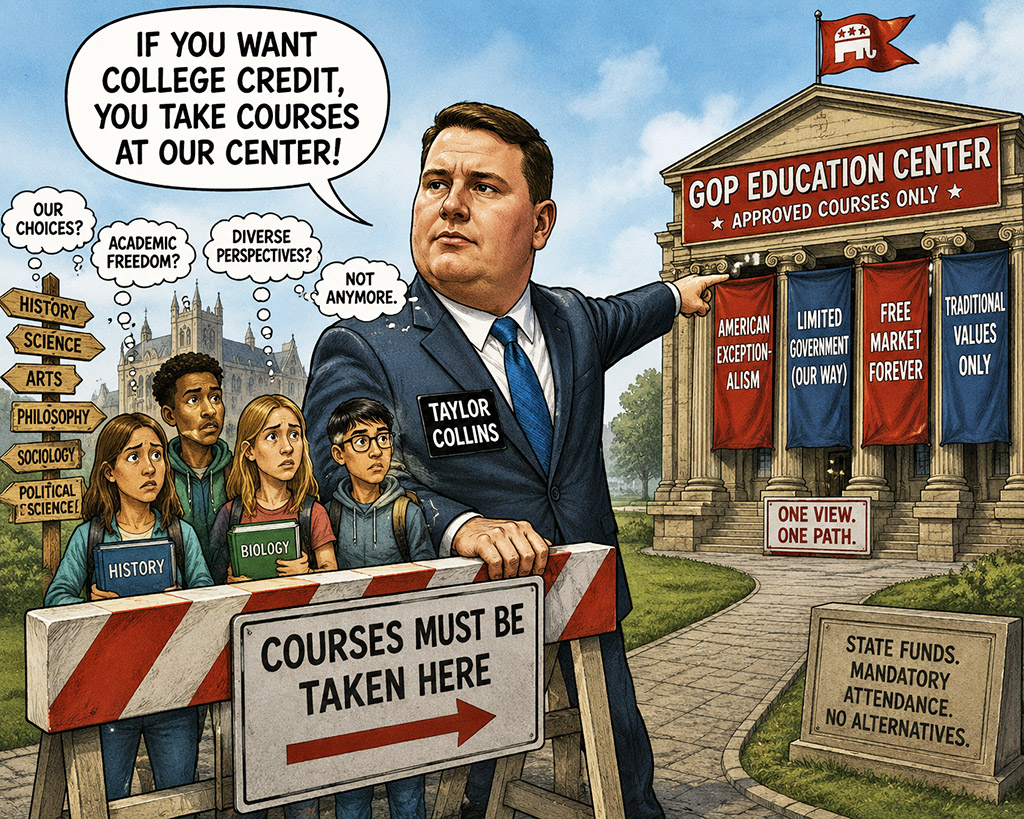
Op-Ed Demonstrates Need for Legislators to Learn about Logic, Critical Thinking, Objective Reasoning, and Intellectual Freedom
Representative Taylor Collins published a Des Moines Register opinion piece on June 7 in defense of House File 2800, and I agree on at least one important point. Civics education matters.
A healthy republic depends upon citizens who understand the Constitution, the structure of government, the rights and responsibilities of citizenship, and the history that shaped our nation. A society in which people cannot identify basic constitutional principles or understand how their government functions is a society vulnerable to misinformation, polarization, and manipulation.
If Iowa’s public universities can do a better job preparing informed citizens, that is a conversation worth having. Unfortunately, that is not the conversation Representative Collins is having. Instead, he uses concerns about civic knowledge to justify something very different: legislative control over university curriculum and restrictions on student choice.
Those are not the same thing.
Collins begins his opinion piece by citing survey results showing that many college students struggle to answer basic questions about American government and history. The statistics are concerning. If accurate, they suggest civic literacy remains a challenge not only in higher education, but throughout American society.
But identifying a problem is only the first step. The more important question is whether the proposed solution addresses it. That is where Collins’ argument begins to break down.
Throughout his editorial, Collins repeatedly points to courses with titles such as “Music and Social Change,” “The Economics of Discrimination,” “Identity, Diversity, and the Media,” and “Magic, Witchcraft, and Religion” as evidence that universities have lost sight of a true liberal arts education.
His implication is clear, that students are taking these courses instead of learning American history and government. Yet Collins never provides evidence that this is happening. Nor does he explain how a course title alone demonstrates a lack of academic rigor.
Anyone familiar with higher education understands that course titles rarely tell the whole story. A course examining religion, belief systems, and cultural history may sound unusual when reduced to a title, but that does not make it frivolous.
Likewise, a course exploring discrimination through an economic lens sounds entirely consistent with the work of economists studying labor markets, public policy, and human behavior.
One can certainly debate the merits of individual courses. Universities do that all the time. But pointing to provocative course titles is not evidence that students are being denied a meaningful education.
More importantly, Collins never demonstrates that these courses are responsible for the civic knowledge deficits he cites. That is the central weakness in his argument.
If students cannot identify James Madison, explain the 13th Amendment, or describe the role of the vice president, Collins assumes the cause must be university curricula. But he offers no evidence connecting the two.
Students spend twelve years in K-12 education before arriving on a college campus. They consume social media, news, entertainment, and information from countless sources. Civic literacy is shaped by families, communities, schools, and culture as much as by university coursework.
To establish his case, Collins would need to show not merely that civic knowledge is lacking, but that the courses he criticizes are causing that deficiency and that the curriculum he supports will improve it.
He never makes that case. Instead, he asks readers to accept it as self-evident.
Even if one accepts Collins’ concerns about civic knowledge, another question remains unanswered. Why restrict student choice?
This is the question missing entirely from his editorial.
Iowa’s public universities already offer courses in American history, political science, constitutional law, economics, public policy, and government. Faculty across multiple departments teach subjects directly related to citizenship and civic engagement.
If the goal is to strengthen civic education, why should students be limited to a single legislatively designated provider? If intellectual freedom is the objective, why not allow multiple departments to offer qualifying courses? If competition improves education, why eliminate competition?
The legislation does not simply require students to study civics. It goes further. It specifies who gets to teach it. That distinction matters.
For years, Iowa political leaders have championed educational choice, competition, and freedom. School choice has become a central theme of state policy. Parents are told they deserve options. Students are told that competition produces better outcomes.
Yet this legislation follows the opposite principle. Instead of expanding choice, it narrows it. Instead of encouraging competition among ideas and academic departments, it designates a preferred pathway and directs students toward it.
Supporters may believe that pathway is superior. But superiority is typically demonstrated through results, not mandates.
That brings us to another fact Collins does not address. When the Center for Intellectual Freedom launched its initial courses, student enrollment was limited. Students had an opportunity to choose those courses voluntarily. Most did not.
Perhaps that reflected scheduling conflicts. Perhaps students were unaware of the offerings. Perhaps the courses were new and unproven. Or perhaps students simply preferred other options.
Whatever the explanation, the response from lawmakers was not to persuade students of the courses’ value. It was to require participation. That authoritarian requirement should give Iowans pause.
The purpose of higher education is not merely to transmit information. It is to cultivate critical thinking, intellectual curiosity, and the ability to evaluate competing ideas. Those goals are best achieved when ideas compete on their merits, not when government guarantees enrollment.
The irony is difficult to ignore. A law promoted in the name of intellectual freedom ultimately reduces academic choice. A policy intended to encourage civic engagement relies on compulsion rather than persuasion. And a reform presented as a defense of liberal arts education concentrates authority rather than expanding it.
Representative Collins is right about one thing. Civics education matters.
One final irony deserves mention. Collins titles his piece “Make Civics Education Great Again,” an unmistakable reference to Donald Trump’s political slogan. He simultaneously argues that civic education should rise above ideology and partisanship.
If civic education is truly nonpartisan, as Collins claims, it is fair to ask why the effort is being marketed using language so closely associated with a specific political movement. Civic education should be about understanding American institutions, history, and democratic principles, not advancing the branding of any political party or politician.
It matters enough that we should have an honest conversation about how it is taught, who teaches it, and what students should learn. But civics education is not strengthened simply because lawmakers declare it so. And intellectual freedom is not advanced by limiting the freedom to choose.
The real question facing Iowa is not whether students should learn about American history and government. Of course they should. Then the question becomes whether a state that increasingly celebrates educational choice should be comfortable denying that choice when it comes to higher education.
That is a debate worth having.
Breaking With Trump, or Just His Poll Numbers?
Candidates show some dissent over the Iran war, as Grassley and Ernst vote against limiting Trump’s war powersIowa Republican candidates are changing their positions on the Iran war as Election Day approaches. That is news. Calling it a “break with Trump” may be...
Has the UI Center Lost Its Academic Legitimacy?
How Much Academic Legitimacy Does Iowa's Center for Intellectual Freedom Have Left?Eleven scholars recruited to help establish the Center have resigned. Their departure raises a bigger question about what made this politically created institution academic in the first...
Trump Lost His Lawsuit. But Did the Lawsuit Fail?
An Iowa judge threw out Donald Trump’s lawsuit against Gannett and pollster J. Ann Selzer. But after nearly two years of litigation, the case raises a larger question about what it means to “win.”President Donald Trump lost his lawsuit against Gannett (owner of the...
As Iowans Suffer, Grassley Turns His Focus to Transgender Sports
Iowa already prohibits transgender girls from competing in girls' sports. With farmers struggling with diesel prices and families confronting inflation and housing costs, why is Chuck Grassley making the issue a national priority now?Should we be concerned about his...
Would a Ban of Diesel Exports Actually Lower Prices? Likely Not.
It’s More Complicated Than Grassley BelievesSen. Chuck Grassley says the U.S. should stop exporting diesel to bring down prices for farmers and truckers. The oil industry says that could backfire. Its explanation deserves a closer look.Iowa farmers are heading into...
Iowa Corn Growers Ask for Diesel Price Relief as Harvest Begins
Iowa Corn Growers Association asks for diesel relief as harvest kicks offBy Cami KoonsIowa Capital Dispatch As Iowa farmers begin harvesting their crops, corn growers in the state are asking Iowa congressional delegates to help lower the cost of diesel fuel, which has...
Mortgage Rates Hit 7% as War Increases Housing Market Pressure
Higher energy prices, persistent inflation, and rising borrowing costs are making an already difficult housing market even harder for buyers.The New York Times reports that mortgage rates have climbed above 7% for the first time since January 2025, another economic...