
The Ezra Totton Scholarship Case Is About More Than One Scholarship
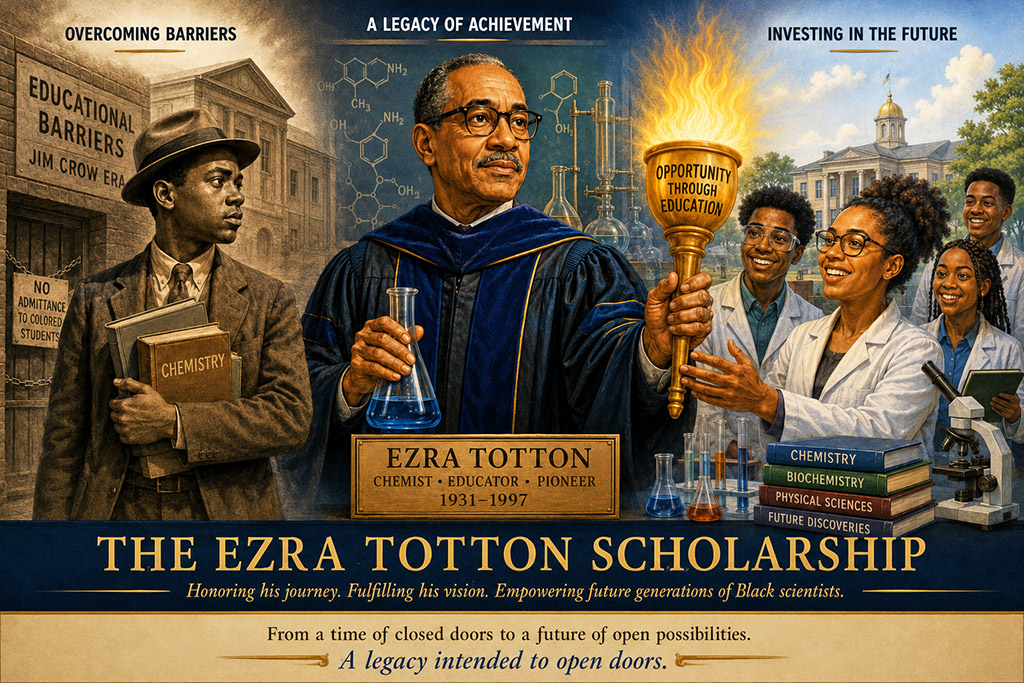
Questions of Donor Intent and Race-Based Aid
The Iowa Supreme Court’s recent ruling involving the University of Iowa and the estate of chemist Ezra Totton is about much more than a scholarship. It is about history, discrimination, and donor intent.
And it is about the increasingly complicated legal and political landscape surrounding efforts to address inequality in America.
Ezra Totton
To understand the case, one must first understand the man behind it. Ezra Totton was a Black scientist who came of age during the Jim Crow era. In 1939, he was among a group of Black students who challenged racial barriers in graduate education after being denied admission to the University of Tennessee.
He eventually earned a master’s degree in chemistry from the University of Iowa and a doctorate in biochemistry from the University of Wisconsin before building a distinguished academic career.
The Totton scholarship
When Totton died in 1997, he left money to support future generations of Black students pursuing careers in science. His instructions were not ambiguous. The scholarship was intended for Black students majoring in the physical sciences, preferably chemistry. That purpose reflected both his personal experiences and the barriers he spent a lifetime overcoming.
For years, the scholarship existed without controversy. Then, the legal landscape changed.
Key SCOTUS opinion
In 2023, the U.S. Supreme Court ruled that race-conscious admissions programs used by Harvard and the University of North Carolina violated the Equal Protection Clause of the Fourteenth Amendment. Although the decision specifically addressed admissions, its effects quickly spread far beyond admissions offices.
Effect of ruling on U.S. universities
Universities across the country began reevaluating scholarships, fellowships, recruitment programs, and diversity initiatives that explicitly referenced race. The University of Iowa found itself confronting the same question faced by many institutions, whether a scholarship restricted to students of a particular race can continue to be administered under the new legal environment.
The university concluded that it could not. Or at least that continuing to do so might be unlawful or impractical
National movement
That conclusion did not emerge in a vacuum. It reflects a broader national movement that has sought to dismantle or significantly restrict race-conscious programs in education. Court decisions, political pressure, legislative action, and public debate have all contributed to an environment in which universities increasingly view such programs as legally vulnerable.
Whether one views those developments as a restoration of equal treatment or a retreat from efforts to address historical inequities depends largely on one’s perspective.
The University of Iowa responded by asking the courts for permission to modify Totton’s scholarship, replacing the requirement that recipients be Black students with a requirement that they be first-generation students.
Iowa Supreme Court draws a line
That is where the Iowa Supreme Court drew a line. The court did not simply order the university to continue administering the scholarship exactly as written. In fact, it largely agreed that the university faces a legitimate legal problem.
What the court rejected was the assumption that a scholarship created to help Black science students could simply be transformed into a scholarship for a different group without serious consideration of the donor’s intent. That distinction matters.
Key element of court’s decision
The court’s decision recognizes something that often gets lost in contemporary political debates. Donors have purposes, and those purposes matter. When individuals leave money to support veterans, rural students, aspiring musicians, cancer research, or scholarships for women in engineering, they generally expect their wishes to be respected.
The same principle applies here. The fact that Totton’s scholarship was created for Black students is not incidental to the story, it is the story.
Totton’s life experiences with discrimination shaped his decision, as did his desire to help future Black scientists. Remove those facts, and the scholarship no longer reflects the purpose for which it was created.
Challenge facing the courts
The challenge facing the courts is obvious. The law may no longer permit the scholarship to operate exactly as Totton envisioned, yet simply ignoring his wishes is difficult to justify as well.
The Iowa Supreme Court appears to have recognized that tension and instructed lower courts to find a solution that honors Totton’s intent to the greatest extent permitted by law.
That is likely the right approach. This case is not merely about race, or scholarships. It is about what happens when the values of one era collide with the legal realities of another.
A bigger question
And it raises a question that extends far beyond the University of Iowa. When society changes, how much authority should institutions have to rewrite the wishes of those who came before them?
That question deserves careful consideration, because the answer will affect far more than a single scholarship.
Breaking With Trump, or Just His Poll Numbers?
Candidates show some dissent over the Iran war, as Grassley and Ernst vote against limiting Trump’s war powersIowa Republican candidates are changing their positions on the Iran war as Election Day approaches. That is news. Calling it a “break with Trump” may be...
Has the UI Center Lost Its Academic Legitimacy?
How Much Academic Legitimacy Does Iowa's Center for Intellectual Freedom Have Left?Eleven scholars recruited to help establish the Center have resigned. Their departure raises a bigger question about what made this politically created institution academic in the first...
Trump Lost His Lawsuit. But Did the Lawsuit Fail?
An Iowa judge threw out Donald Trump’s lawsuit against Gannett and pollster J. Ann Selzer. But after nearly two years of litigation, the case raises a larger question about what it means to “win.”President Donald Trump lost his lawsuit against Gannett (owner of the...
As Iowans Suffer, Grassley Turns His Focus to Transgender Sports
Iowa already prohibits transgender girls from competing in girls' sports. With farmers struggling with diesel prices and families confronting inflation and housing costs, why is Chuck Grassley making the issue a national priority now?Should we be concerned about his...
Would a Ban of Diesel Exports Actually Lower Prices? Likely Not.
It’s More Complicated Than Grassley BelievesSen. Chuck Grassley says the U.S. should stop exporting diesel to bring down prices for farmers and truckers. The oil industry says that could backfire. Its explanation deserves a closer look.Iowa farmers are heading into...
Iowa Corn Growers Ask for Diesel Price Relief as Harvest Begins
Iowa Corn Growers Association asks for diesel relief as harvest kicks offBy Cami KoonsIowa Capital Dispatch As Iowa farmers begin harvesting their crops, corn growers in the state are asking Iowa congressional delegates to help lower the cost of diesel fuel, which has...
Mortgage Rates Hit 7% as War Increases Housing Market Pressure
Higher energy prices, persistent inflation, and rising borrowing costs are making an already difficult housing market even harder for buyers.The New York Times reports that mortgage rates have climbed above 7% for the first time since January 2025, another economic...